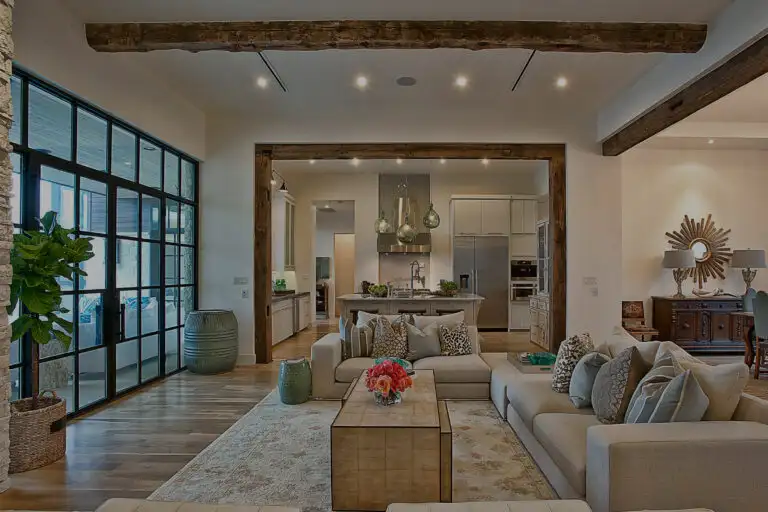
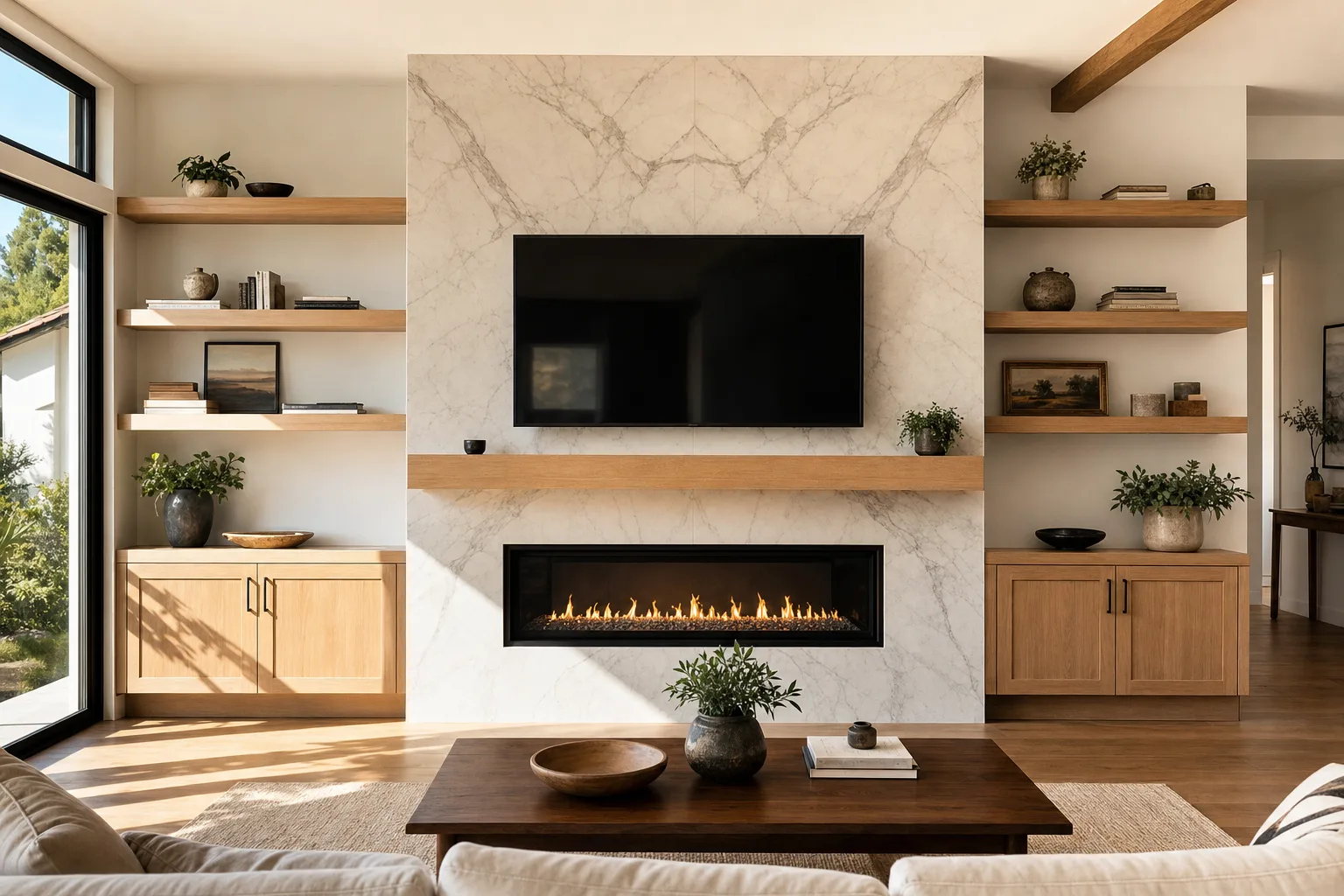
There are three ways to remodel a fireplace. You can reface the one you have, rebuild it as a new gas fireplace wall with built-ins, or frame an electric unit into a new wall. The first changes finish only. The second touches gas, venting and framing. The third touches framing and a circuit. In the cities we checked, a cosmetic reface is usually the lightest route; a new gas fireplace or a new framed wall is permit work. Check your city's list.
The route decides the permit, the clearances and the rules you have to design around. Wood burning is the one option the air district has mostly closed to new work. This guide quotes the rules we could open and read, and says where we could not.
The three routes at a glance
Start with what you want the wall to do. Then match it to what each route touches.
- Reface. The firebox and chimney stay. The facade, mantel and hearth finish change. Best when the fireplace works and the look is the problem.
- Rebuild. A new gas fireplace in a framed wall, usually with a TV niche and built-ins. Best when you want a different size, position or a full feature wall.
- Go electric. A linear electric unit framed into a wall, with no flue and no gas. Best for a room that has no chimney and never will.
Our fireplace remodeling page shows design looks for each. This guide is about the rules behind them.
Reface: what it touches
A reface covers the old brick or stone with a new face: large-format tile, stone, plaster or board. The mantel and the hearth finish usually change too. The firebox, the flue and any gas stay where they are.
Before you pick a material
- The brick has to be sound. If the old facade has loose or cracked masonry, a new face does not fix it. Open it and look first.
- Clearance still applies. A wood mantel or wood trim on a masonry fireplace follows the code distances in hearth and clearance rules. Tile and stone are not combustible, so they can sit closer. Wood and board cannot.
- The hearth extension stays the size the code requires. Retiling is fine; shrinking it is not.
- Gas logs and wiring stay put. Move either and the job is no longer finish work.
Whether a facade-only reface needs a permit depends on the city. See permits.
What this means for your project
Which route fits depends on your firebox, flue and hearth. Dallas can tell you which of the three applies to your fireplace, and the written quote names the permit.
CSLB #1045801 · 4.6 from 19 Google reviews · Dallas answers the phone
Rebuild: a new gas fireplace wall
A rebuild removes the old fireplace and builds a new wall: framing, a factory-built gas fireplace, a vent run to the outside, a finish, and often a TV niche and cabinets on both sides.
What it touches
- Framing. The wall around the unit is built to the unit's installation sheet, not to a standard stud layout.
- Gas. A gas line is permit work. Claremont's list of permit items names "Plumbing work" and "Electrical work"; confirm with your city how it treats a new gas line.
- Venting. A direct-vent unit runs intake and exhaust pipe to the outside. The manufacturer's sheet sets the pipe, the termination and the clearances.
- Electrical. The unit, the TV and the lighting need power, and often a new circuit.
- Installer. One manufacturer sheet we read says the fireplace "must be installed by a qualified (certified or licensed) service person," because "carbon monoxide leakage (spillage) can occur" if the glass door and vent pipe are not sealed.
Factory-built means listed. The 2022 California Residential Code R1004.1: "Factory-built fireplaces shall be listed and labeled and shall be installed in accordance with the conditions of the listing." R1004.2 adds that the hearth extension "shall be installed in accordance with the listing of the fireplace." (CRC 2022, chapter 10) So the unit you buy sets the hearth, and the hearth belongs in the plan before the floor.
Carbon monoxide. CPSC says to "have the heating system professionally inspected and serviced annually" and to install CO alarms "on every level of the home and outside sleeping areas." (CPSC, Carbon Monoxide Information Center and Questions and Answers) Fuel-burning means CO is on the list, and the alarms are part of the plan.
Go electric: what it touches
An electric fireplace needs no gas line, no flue and no vent pipe. It is framed into a wall like a media wall: the unit, a TV above or beside it, and shelves or cabinet doors.
- Power. The unit has its own electrical requirements. Check the installation sheet for the exact model; we did not open one for this guide.
- Framing and finish. The wall is built to the unit's sheet, the same way as a gas unit.
- Heat. Electric units still give off heat. The TV and shelf clearances come from the manufacturer's sheet for that model.
- No chimney needed. This is the route when the room has no chimney, or you want to close off one that does not work.
Because it adds a circuit and may open walls, ask your city whether your project needs a permit. See permits.
Hearth and clearance rules
These numbers come from the 2022 California Residential Code, chapter 10 (read November 13, 2026 on UpCodes). They set where the mantel goes and how far the hearth reaches.
Masonry fireplaces
- Hearth extension (R1001.10). "Hearth extensions shall extend not less than 16 inches (406 mm) in front of and not less than 8 inches (203 mm) beyond" each side of the opening. "Where the fireplace opening is 6 square feet (0.6 m2) or larger, the hearth extension shall extend not less than 20 inches" in front and 12 inches beyond each side.
- Noncombustible support (R1001.9). Hearths and extensions must be "supported by noncombustible materials."
- Framing clearance (R1001.11). "Wood beams, joists, studs and other combustible material shall have a clearance of not less than 2 inches (51 mm)" from the front faces and sides of masonry fireplaces, and not less than 4 inches from the back faces. "The airspace shall not be filled, except to provide fireblocking."
- Mantels and trim (R1001.11, exception 4). Combustible mantels or trim are allowed on the masonry front "providing such combustible materials are not placed within 6 inches (152 mm) of a fireplace opening." And: "Combustible material within 12 inches (306 mm) of the fireplace opening shall not project more than 1/8 inch (3 mm) for each 1-inch (25 mm) distance from such an opening."
That last rule is why a thick wood beam sits higher than you expect.
Gas and electric units
Factory-built units follow their listing (R1004.1, R1004.2, quoted above). The sheet for the unit you pick is the rule.
TV above the fireplace
One manufacturer sheet we read (Innovative Hearth Products, Allume48TEN linear gas) says: "Most television manufacturers instruct the homeowner to not place the television above a heat source." It suggests "12" minimum on a flush wall and at 18" for a recessed installation," and adds "Clearances to TV are provided only for guidance, please follow TV manufacturer's recommendation for installation." It also warns: "Ensure clearances to combustibles are maintained when building a mantel or shelves above the fireplace."
That is one model. A different unit has different numbers. Pick the unit and the TV, read both sheets, then draw the wall.
Wood burning: what the air district allows
The San Gabriel Valley is in the South Coast Air Quality Management District. Its Rule 445, amended September 5, 2025, covers wood-burning devices.
- No new wood-burning in new development. Rule 445(d)(1): "No person shall permanently install a Wood-Burning Device into any New Development." New Development means construction that begins "on or after March 9, 2009."
- A short list for anything new or used. Rule 445(d)(2): no one may "sell, offer for sale, supply, or install" a new or used permanently installed wood-burning or gaseous-fueled device "unless it is one of the following": an EPA-certified wood-burning heater, a pellet-fueled heater, a masonry heater, or "A Dedicated Gaseous-Fueled Fireplace."
- No-burn days. Rule 445(e): no one may operate an indoor wood-burning device on a calendar day in the wood-burning season that is declared a "No-Burn" day. The PM2.5 season is "the consecutive entire four (4) months of November, December, January, and February."
Exceptions exist. Rule 445(i) lists them, including properties with no gas service within 150 feet of the property line and certain historic sites. Whether one applies to you is a question for the district, not for us.
What this means for a remodel. If you want a flame, plan on gas or electric. An existing wood fireplace can stay, but it is subject to no-burn days. (South Coast AQMD, Rule 445)
Which routes need a permit
Cities differ. Here is what we read, and what we did not.
- Claremont. "Projects that are cosmetic, such as painting, wallpapering, carpeting, cabinets and interior trim do not require a permit." Its permit list, which it says is "not all-inclusive," names "Plumbing work," "Electrical work, including: upgrade, repair or relocation of electrical panel," and "Demolition of all or a portion of building or structure." Fireplaces are not mentioned. (City page, read November 13, 2026)
- Azusa. A permit is required when a structure is "erected, constructed, enlarged, altered, repaired." The page does not mention fireplaces or gas. Call the Building Division. (City page, read November 13, 2026)
- San Dimas, Glendora, La Verne, Covina and West Covina. Each city's rules are on its page in our permit guide. Glendora puts even base cabinets and countertops on its permit list, so do not assume a facade is exempt there. La Verne has no published list, and the state code baseline exempts finish work such as tiling.
Our plain reading. A facade that changes finish only, with the firebox, gas and wiring untouched, is the likeliest to be finish work. A gas line is permit work. A new circuit, a new vent, new framing or a moved firebox are permit work too. We pull permits for the jobs we build. Each city page lists its own rules: San Dimas · Glendora · La Verne · Claremont · Covina · West Covina · Azusa. The code and permit note on our fireplace page has the short version.
If a bigger project is in play, such as a new living room floor and a fireplace wall together, see whole-home remodeling.
Questions to ask before you sign
- "Which of the three routes is this, and what does it touch?" The answer should name the firebox, the gas, the venting and the wiring.
- "Which unit, and where is its installation sheet?" The wall, the hearth and the TV height come from that sheet.
- "Does the hearth stay the size the code requires?" Ask for the number.
- "Who pulls the permit, and does it cover the gas line?" The contract should say.
- "What happens if the old firebox is cracked when you open it?" The answer should be: stop, show you, price it, in writing, before the work changes.
- "Does this plan avoid anything the air district prohibits?" If wood burning is in the plan, ask how.
For how we handle price, changes and payments, see how we work. When you are ready, get a written, fixed-price quote or call Dallas at (626) 991-8219.
Questions we get
Do I need a permit to reface a fireplace?
Often not for the facade alone, but it depends on the city. Claremont says "Projects that are cosmetic, such as painting, wallpapering, carpeting, cabinets and interior trim do not require a permit." Azusa requires one when a structure is "altered." Ask your city before you start, and treat any gas, wiring or firebox change as permit work.
Can I add a wood-burning fireplace to my house?
In the South Coast air basin, almost certainly not. Rule 445 says "No person shall permanently install a Wood-Burning Device into any New Development," and any new or used device sold or installed must be on the rule's short list, which includes a dedicated gas fireplace. Exemptions exist for narrow cases, such as no gas service within 150 feet of the property line. Ask the air district.
Can I put the TV above the fireplace?
Only if the wall is built to the installation manual of the unit you buy, and to the TV maker's heat limits. One linear gas manual we read says to consider "12" minimum on a flush wall and at 18" for a recessed installation," as guidance only. Another unit will differ, so read the sheet for the exact model first.
Is a gas fireplace a carbon monoxide risk?
Any fuel-burning appliance can be. CPSC says to have heating systems "professionally inspected and serviced annually," and one gas fireplace manual we read warns that carbon monoxide leakage can occur if the glass door and vent pipe are not properly sealed. Put a working CO alarm on every level and outside sleeping areas, as CPSC advises.
Does the hearth have to stay the same size?
On a masonry fireplace, the code sets a minimum hearth extension, and a new floor or a new surround has to leave it in place. On a factory-built unit, the hearth extension follows the unit's listing. Either way, the size is checked before the tile goes down, not after.
Note: general background, not legal advice or engineering advice. Codes and air rules change; confirm with your city and the air district before you start.
Sources
All pages opened and read November 13, 2026. Rules change. Confirm with your city and the air district before you start work.
Every source, with the date we read it
Air rules
- South Coast AQMD, Rule 445, Wood-Burning Devices (amended September 5, 2025, PDF): https://www.aqmd.gov/docs/default-source/rule-book/rule-iv/rule-445.pdf (read November 13, 2026)
Building code
- 2022 California Residential Code, chapter 10, Chimneys and Fireplaces (UpCodes): https://up.codes/viewer/california/ca-residential-code-2022/chapter/10/chimneys-and-fireplaces (read November 13, 2026)
Manufacturer installation sheet
- Innovative Hearth Products, Allume48TEN Direct-Vent Linear Gas Fireplace, installation and operation instructions, rev. C 10/2024 (PDF; one model, used as an example only): https://ihp.us.com/wp-content/uploads/2022/11/901226-00_C_AST_Allume-48-and_DLX_TEN-B_DV_FPs_ECO_IICO.pdf (read November 13, 2026)
Carbon monoxide
- CPSC, Carbon Monoxide Information Center: https://www.cpsc.gov/Safety-Education/Safety-Education-Centers/Carbon-Monoxide-Information-Center (read November 13, 2026)
- CPSC, Carbon Monoxide Questions and Answers: https://www.cpsc.gov/Safety-Education/Safety-Education-Centers/Carbon-Monoxide-Information-Center/Carbon-Monoxide-Questions-and-Answers (read November 13, 2026)
City building pages
- City of Claremont, When do I need a permit?: https://www.claremontca.gov/Business-Development/Building-and-Construction/Building-Permits-and-Plan-Checks/When-do-I-need-a-permit (read November 13, 2026)
- City of Azusa, Building Permits: https://azusaca.gov/117/Building-Permits (read November 13, 2026)