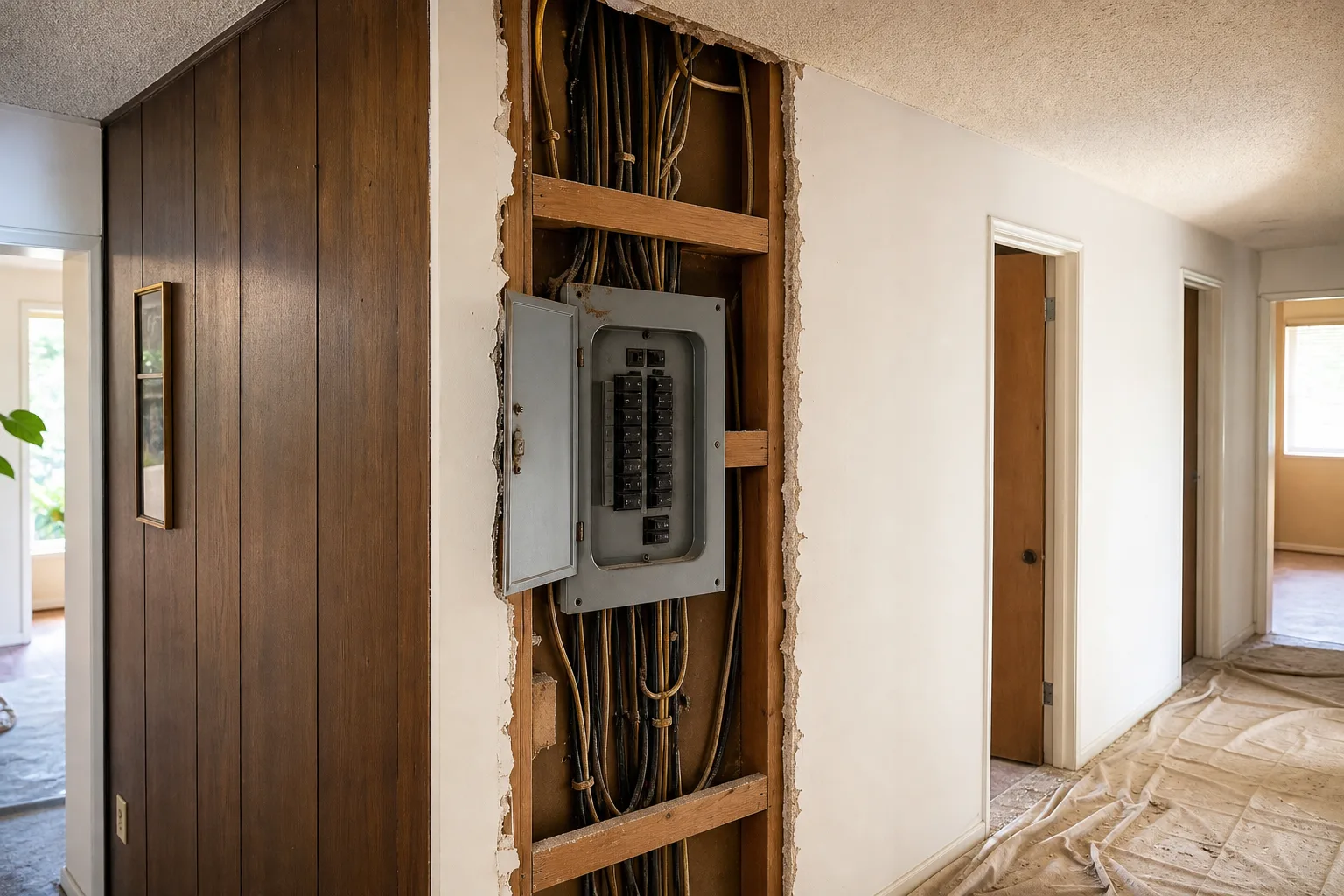
Older San Gabriel Valley houses can hide things that change a remodel. A house from the 1960s or early '70s may have lead paint, asbestos in old floor tile or textured paint, aluminum wiring, worn galvanized pipe, or framing that was never bolted to its foundation. Many have none of these. You can't see most of them from the street, and often not until a wall is open.
That is also why the only real number is a written quote from a licensed contractor who has seen the room. A price list for remodels is a guess about a house the writer has never seen.
Lead paint (homes built before 1978)
The federal cutoff is 1978. EPA's Renovation, Repair and Painting (RRP) rule covers homes, childcare facilities and preschools built before 1978. A house built from the 1960s through 1977 is inside that line. A house built in 1978 or 1979 is not.
The rule says anyone paid to perform work that disturbs painted surfaces in those buildings must be certified. Their employees must be trained, as certified renovators or on the job under one, in lead-safe work practices. EPA says this includes all firms, even sole proprietorships.
The same EPA page says homeowners working on their own pre-1978 home are generally not covered, unless they rent part of it, run a childcare center there, or renovate homes to sell for profit. Being inside the line means paint may contain lead. It does not mean it does.
What it means for your remodel: Demolition, cutting into walls and pulling trim can disturb paint. If your house was built before 1978, ask any contractor you hire whether the firm is EPA lead-safe certified and how it handles paint before demolition starts.
Asbestos (older materials)
EPA's "Learn About Asbestos" page lists materials that may contain asbestos. Several are common in older houses: textured paint and patching compounds used on walls and ceilings, vinyl floor tiles, the backing on vinyl sheet flooring, adhesives, and pipe insulation.
EPA says fibers may be released during "demolition work, building or home maintenance, repair, and remodeling," and that exposure generally happens when the material is disturbed or damaged.
You can't tell by looking. EPA says it is not possible to tell whether a material contains asbestos simply by looking at it. For a renovation that would disturb the material, EPA recommends having it sampled by a properly trained and accredited asbestos professional, who then uses a qualified laboratory.
What it means for your remodel: If a job will demolish a ceiling, floor or wall finish from this era, testing before demolition is how you find out. A result can add time and a separate specialist to the scope.
What this means for your project
Most houses in our seven cities were built before 1980. Dallas looks at the panel, the pipe and the finishes before the quote is written, so the surprises are on paper first.
CSLB #1045801 · 4.6 from 19 Google reviews · Dallas answers the phone
Electrical: aluminum wiring and older panels
Aluminum branch wiring. The U.S. Consumer Product Safety Commission (CPSC) says a copper shortage in the mid-1960s led builders to use aluminum wire on general-purpose 15- and 20-amp circuits. Homes built before 1965 are unlikely to have it. Cables installed between 1965 and the mid-1970s, in new homes, additions and new circuits, may contain it.
CPSC says the fire hazard is at the connections: receptacles, switches, junction boxes and some appliances. Failing connections seldom give easy warning signs. Cable with aluminum conductors is marked "Al" or "Aluminum" on the jacket, visible in unfinished basements, attics or garages. CPSC says to have a qualified electrician determine the cause of any sign of trouble and not to do it yourself.
Older panels. CPSC's Guide to Home Wiring Hazards (Publication 518) says an electrical inspection should be done by a qualified electrician or licensed electrical inspector. It calls an inspection overdue if the last one was 40 or more years ago, and says to use the age of the house as a guide if no record is on the panel.
On specific panel brands: CPSC closed its two-year investigation of Federal Pacific Electric Stab-Lok breakers in 1983 without deciding whether they are safe. We found no government or utility source that rates Zinsco panels. So the safe step is the plain one: ask a qualified electrician to inspect the panel.
What it means for your remodel: A new kitchen or bath adds circuits. An older panel may have no room for them, or may need work before an inspector passes new ones. Aluminum branch wiring, if present, is an electrician's decision before new work ties into it.
Plumbing: galvanized supply pipe
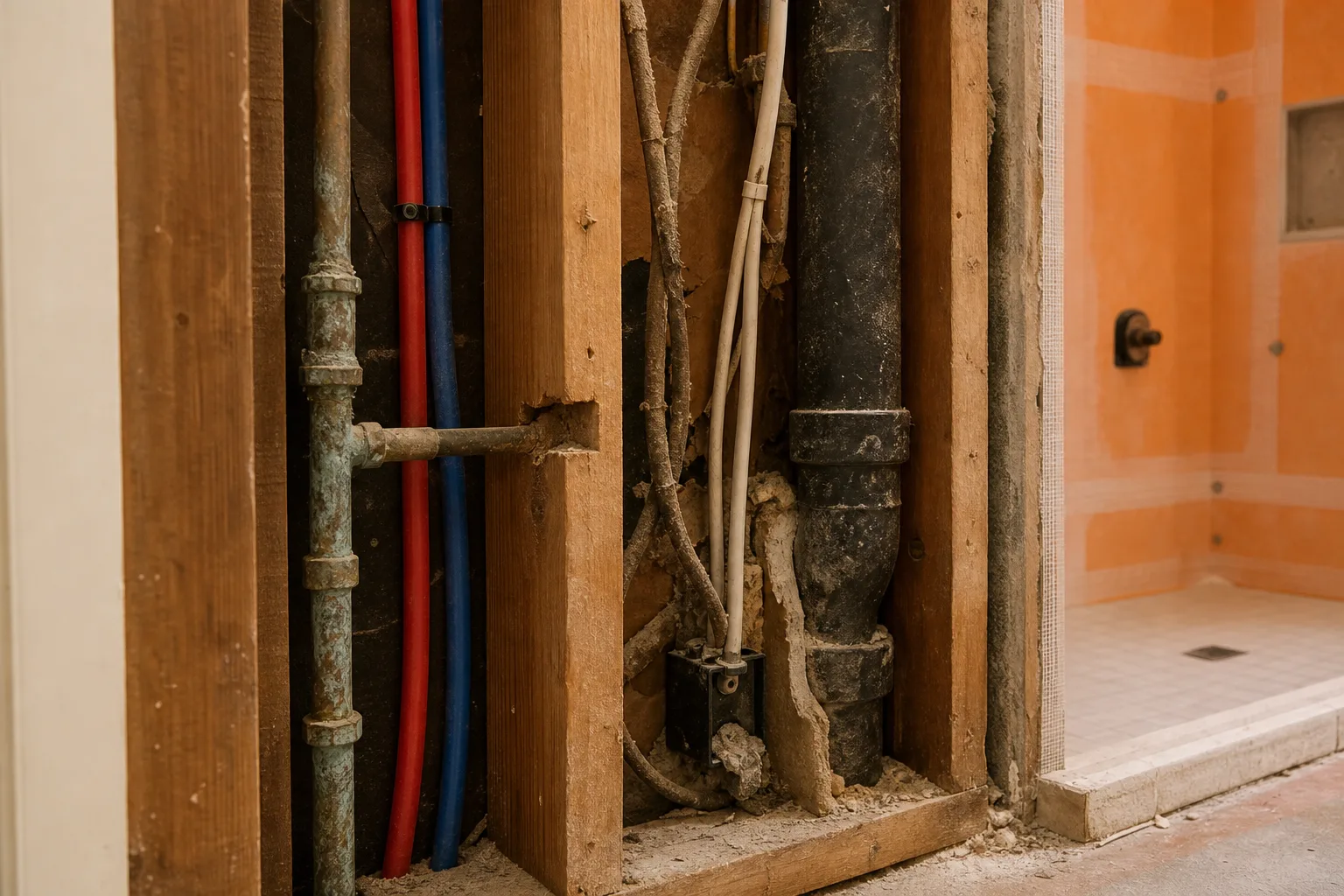
Saint Paul Regional Water Services (a Minnesota utility, so general background, not a California rule) says galvanized pipe was used from the 1880s to the 1960s. It says the pipe loses its zinc coating over years of exposure to minerals in the water and corrodes from the inside out. That narrows the pipe, can cause low water pressure, and can release iron that stains water and sinks brown. The utility says galvanized pipe will eventually rust through and leak, and that replacing it with copper or PEX may be worth considering if you see low pressure, rust or leaks.
Because the utility dates it to the 1960s at the latest, houses from the early part of this era may have it and later ones may not.
What it means for your remodel: Tying a new sink, shower or dishwasher into worn supply pipe can mean replacing some of it. Moving a fixture means new drain and supply lines, and often work below the floor.
Ventilation and energy rules (Title 24)
California's energy code (Title 24, Part 6) has mandatory measures for homes. The California Energy Commission's page says that for single-family alterations, altered lighting systems must meet Section 150.0(k). Existing screw-base sockets in ceiling-recessed fixtures need not be removed if new compliant trim kits or lamps are installed.
The Energy Commission's 2025 single-family summary lists the lighting measures. New luminaires must meet efficacy rules. Recessed ceiling downlights must not have screw-based sockets and must be airtight. In bathrooms, at least one luminaire must be controlled by an occupancy or vacancy sensor with automatic-off. Kitchen lighting needs wall-mounted dimming controls, with exceptions such as lighting built into range hoods and bath fans.
Most remodels add or upgrade a bath exhaust fan. The city will tell you whether Title 24 requires it on your permit.
Cities point to these rules too. Glendora's 2025 kitchen and bath handouts and San Dimas's plan-check page (2025 California Codes) are covered in remodel permits in the SGV.
What it means for your remodel: Old baths often have no fan, or one that vents into the attic. Lighting changes can trigger the lighting rules for what you touch. Ask which parts of the energy code your city applies to your scope.
Seismic items common in older SGV houses
Cripple walls and foundation bolting. The Earthquake Brace + Bolt (EBB) program is run by the California Residential Mitigation Program. It says an EBB retrofit is "only done on wood-framed, pre-1980 homes with a raised foundation." If the house has short cripple walls (4 feet or less) in the crawl space, the walls are braced with plywood or OSB and the frame is bolted to the foundation. If the frame sits directly on a concrete stem wall, only bolting is needed. The goal is to help keep the house from sliding off its foundation in an earthquake.
The program exists and is offered by ZIP code. Check whether your ZIP is eligible on the Earthquake Brace + Bolt page.
Water heater strapping. California requires water heaters to be strapped; your contractor should confirm the current code.
What it means for your remodel: A kitchen or bath job that opens a floor can expose the crawl space. If your house is pre-1980 on a raised foundation, ask whether the cripple walls are braced and bolted. If the job touches a water heater, check the strapping.

How this changes a quote
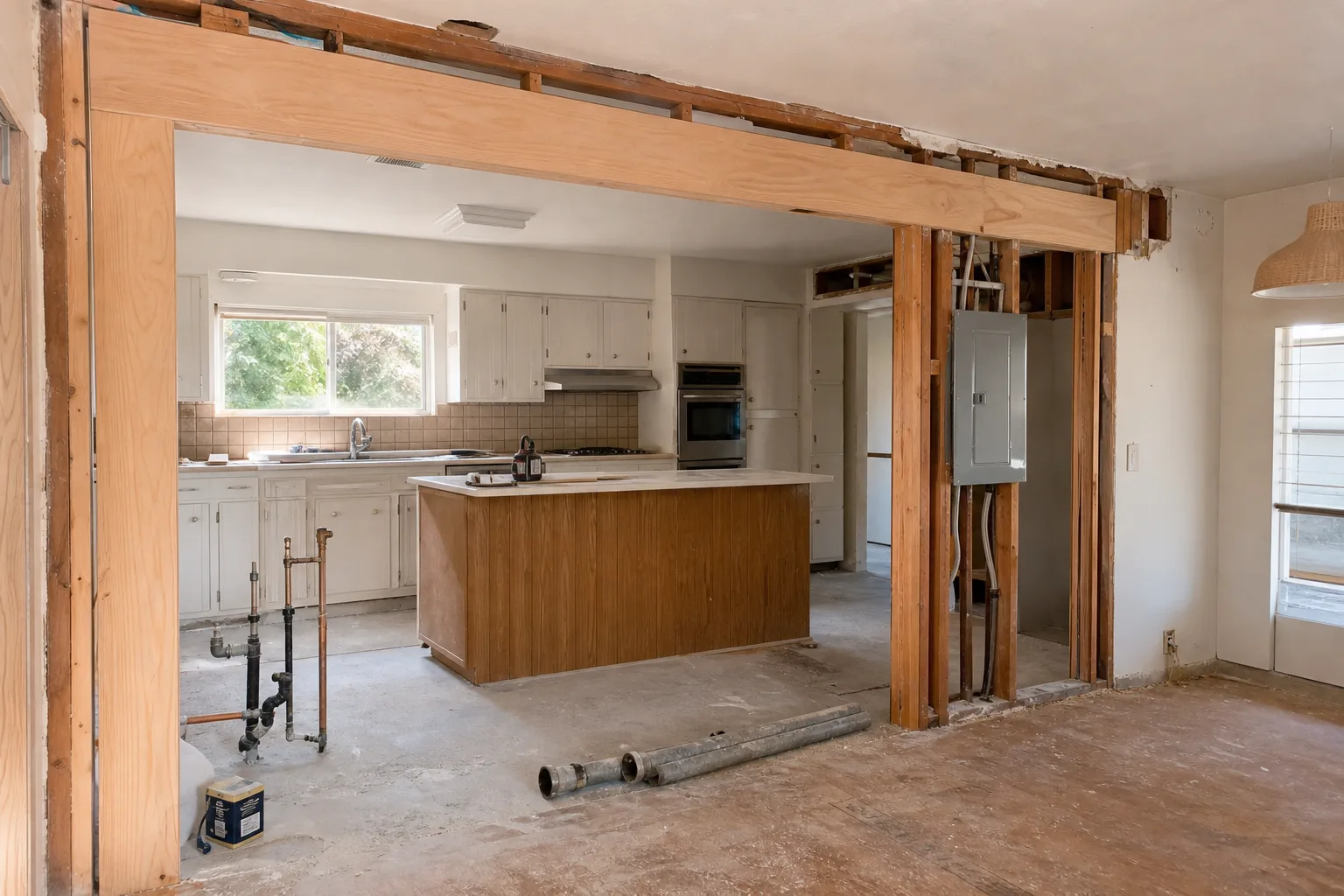
Each item above is something a website can't see. That is why we don't print a price list (see the cost guide). A written quote comes from someone who has seen the room.
What a good quote shows, ours or anyone's: the work by phase, every material and who picks it, what is included and what is not, the payment schedule and the license number. Ours is written, itemized and fixed. The price on it is the price for the work on it (CSLB #1045801).
If the job changes once a wall is open, the price changes only in writing, with your OK first. A fixed price doesn't mean nothing can happen. It means nothing happens to your price behind your back. More: how we work, including what happens when a wall opens up and change orders.
Questions to ask any contractor
- "Are you EPA lead-safe certified, and can I see it?" For a house built before 1978, EPA says paid work that disturbs paint needs a certified firm.
- "How do you handle testing for lead and asbestos before demolition?" Ask who tests, who reads the result and what it does to the scope.
- "What happens if you open a wall and find something?" The answer should be: written change, priced before work, approved by you.
- "Which permits does my job need, and who pulls them?" See remodel permits in the SGV.
- "Will someone look at the panel and the supply pipes before the quote is final?" A quote written without that look is a guess about what is behind the wall. Check the license at cslb.ca.gov first.
Questions we get
Does a house built in the 1970s have lead paint?
The federal rule covers homes built before 1978. A 1975 house is inside that line. A 1979 house is outside it. Inside the line means paint may contain lead, not that it does. For paid work that disturbs paint in a pre-1978 home, EPA requires a certified firm.
Can old textured paint or floor tile contain asbestos?
Maybe. EPA lists textured paint, patching compounds, vinyl floor tiles and pipe insulation among materials that may contain asbestos. You can't tell by looking. Before a renovation disturbs them, EPA recommends sampling by an accredited asbestos professional using a qualified lab.
Do I have to rewire a 1960s house?
Not necessarily. CPSC says homes built before 1965 are unlikely to have aluminum branch wiring. Cable installed from 1965 to the mid-1970s may. Look for "Al" marked on the cable, and have a qualified electrician inspect, not guess. Whether any rewiring is needed depends on what they find.
Do I need to replace galvanized water pipe?
Not always. One utility says galvanized pipe corrodes from the inside and eventually rusts through. It suggests considering replacement if you see low pressure, rust or leaks. Whether a new kitchen or bath can tie into your pipe depends on its condition. A plumber needs to look.
Can you give me a fixed price without seeing my house?
No. A written quote comes from a licensed contractor who has seen the room. After you sign, the price changes only if the job changes, in writing, with your OK first. See the cost guide.
Note: general background, not a statement about your house. Rules and programs change; confirm before you start work.
Sources
All pages opened and read November 6, 2026. Rules and programs change. Confirm before you start work.
Every source, with the date we read it
Lead
- EPA, Renovation, Repair and Painting Program: https://www.epa.gov/lead/renovation-repair-and-painting-program (read November 6, 2026)
Asbestos
- EPA, Learn About Asbestos: https://www.epa.gov/asbestos/learn-about-asbestos (read November 6, 2026)
- EPA, "I'm remodeling my home. Do I need to be concerned about asbestos in the building materials?": https://www.epa.gov/asbestos/im-remodeling-my-home-do-i-need-be-concerned-about-asbestos-building-materials (read November 6, 2026)
Electrical
- CPSC, Repairing Aluminum Wiring, Publication 516, June 2011 (PDF): https://www.cpsc.gov/s3fs-public/516.pdf (read November 6, 2026)
- CPSC, Guide to Home Wiring Hazards, Publication 518 (PDF): https://www.cpsc.gov/s3fs-public/518.pdf (read November 6, 2026)
- CPSC, "Commission Closes Investigation Of FPE Circuit Breakers And Provides Safety Information For Consumers," 1983: https://www.cpsc.gov/Newsroom/News-Releases/1983/Commission-Closes-Investigation-Of-FPE-Circuit-Breakers-And-Provides-Safety-Information-For-Consumers (read November 6, 2026)
Plumbing
- Saint Paul Regional Water Services, plumbing info for homeowners (a Minnesota utility, so general background): https://stpaul.gov/departments/saint-paul-regional-water-services/customer-resources/plumbing-info-for-homeowners (read November 6, 2026)
Energy
- California Energy Commission, 2025 Single-Family Residential Mandatory Requirements Summary (PDF): https://www.energy.ca.gov/sites/default/files/2025-04/2025_Residential_Mandatory_Measures_Summary_ADA.pdf (read November 6, 2026)
- California Energy Commission, Energy Code Support Center, 2025: https://www.energy.ca.gov/programs-and-topics/programs/building-energy-efficiency-standards/energy-code-support-center-5/2025 (read November 6, 2026)
Seismic
- California Residential Mitigation Program, Earthquake Brace + Bolt retrofit page: https://www.crmp.org/our-seismic-retrofit-programs/the-retrofits/ebb-retrofit (read November 6, 2026)