Before a remodel disturbs an older house in the South Coast air district, asbestos has to be surveyed (South Coast AQMD Rule 1403), and in a pre-1978 house a paid renovator has to follow EPA's lead-safe rules. Two sets of rules apply before a remodel touches an older house in our area. EPA's lead rule covers paid work that disturbs paint in homes built before 1978. South Coast AQMD's Rule 1403 covers asbestos before any demolition or renovation, and it says the survey comes first.
Neither rule means you can't remodel. Both are about the order of work: find out what is there, then decide who handles it. Our older-home guide covers the full list of what a 1960s or '70s house can hide. This post goes deeper on two items, the testing and the rules around it.
Where a page would not open for us, we say so rather than fill in from memory.
The federal lead rule (EPA RRP)
EPA's Renovation, Repair and Painting (RRP) page says "anyone paid to perform work that disturbs paint in housing and child-occupied facilities built before 1978" must be certified. It adds: "This includes all firms, even sole proprietorships." (EPA, RRP Program page)
EPA's Small Entity Compliance Guide spells out three layers:
- The firm is certified. "All firms must be certified (even sole-proprietors)."
- The renovators are trained. "All renovators must be trained."
- Lead-safe work practices are followed. The guide's examples: "Work-area containment to prevent dust and debris from leaving the work area," a ban on open-flame burning and on power tools "without HEPA exhaust control," and a "thorough clean up followed by a verification procedure."
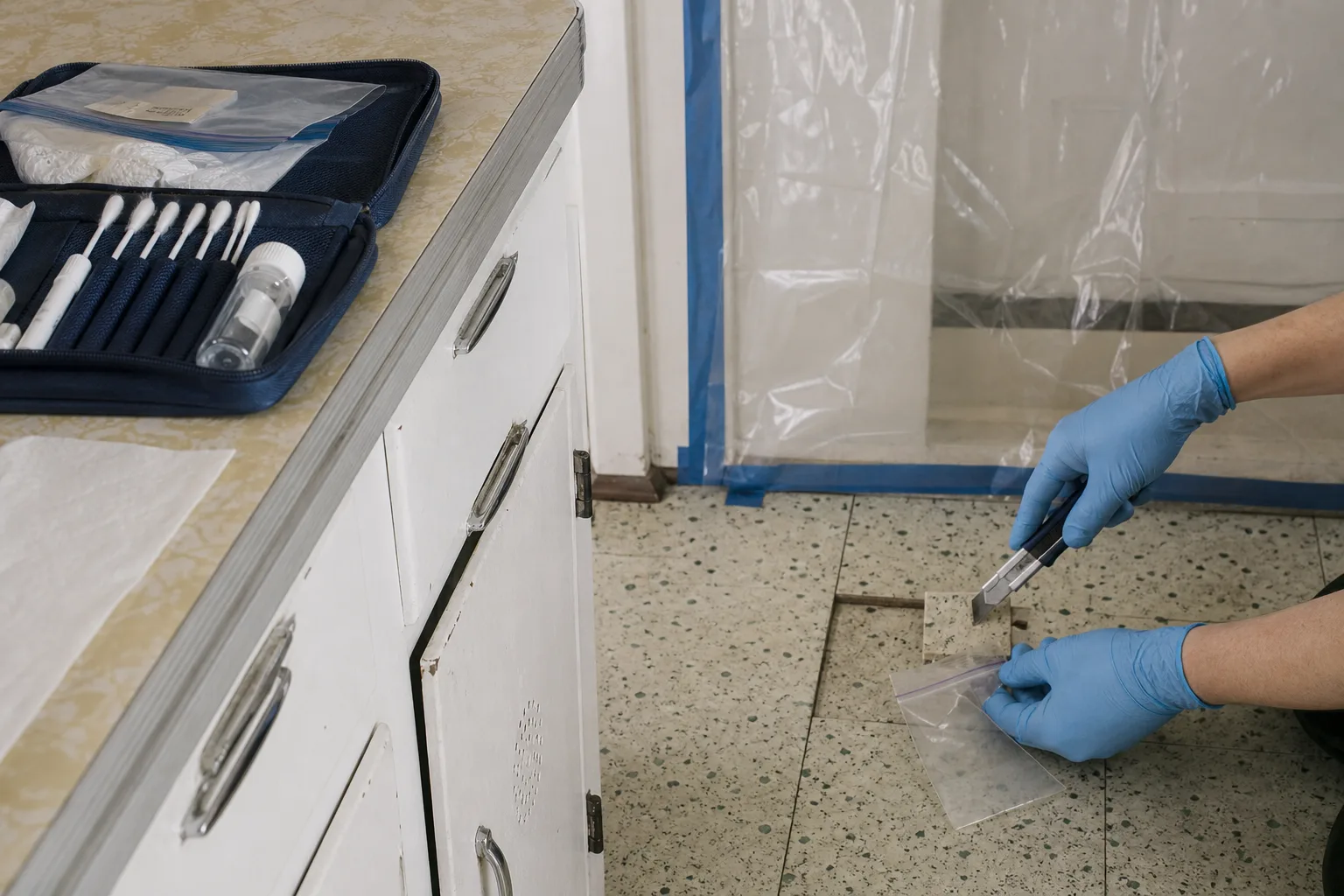
For an interior job, the guide's list includes covering the floor "with taped-down plastic sheeting," closing and covering ducts in the work area, and closing windows and doors, with doors "covered with plastic sheeting." That is why you see plastic taped over a doorway in the picture at the top of this page. (Small Entity Compliance Guide, March 2026)
The pamphlet. The guide says that in pre-1978 housing the contractor must "distribute EPA's lead pamphlet" to the owner and occupants "before renovation starts," and get confirmation of receipt. Records are kept for three years. The pamphlet itself opens: "Always ask to see your contractor's certification." (Small Entity Compliance Guide; Renovate Right pamphlet)
Homeowners. EPA: "In general, the RRP Rule does not apply to homeowners doing RRP projects in their own pre-1978 home." That is a rule about who is covered. It does not make the dust safe. (EPA, RRP Program page)
The 6 and 20 square foot thresholds
People quote these numbers a lot, and often wrongly. EPA's guide excludes "minor repair and maintenance activities that disturb six square feet or less of paint per room inside, or 20 square feet or less on the exterior of a home or building." The very next line: "minor repair and maintenance activities do not include window replacement and projects involving demolition or prohibited practices." (Small Entity Compliance Guide)
A kitchen or bath remodel that takes out cabinets, opens walls or pulls trim involves demolition. The thresholds are written for small repairs, not for a remodel. The guide also defines renovation broadly: "any activity that disturbs painted surfaces and includes most repair, remodeling, and maintenance activities, including window replacement."
What it means for your remodel: if the house is pre-1978 and the job is a remodel, plan as if the rule applies, unless a certified inspector, risk assessor or renovator has found the components lead-free. The guide lists that as an exclusion.
What this means for your project
If your house is older, ask before demo, not after. Dallas can explain how testing fits your schedule and your quote.
CSLB #1045801 · 4.6 from 19 Google reviews · Dallas answers the phone
Test kit or certified inspector?
There are three ways to handle the paint question. The Renovate Right pamphlet lists them:
- Assume it contains lead. The pamphlet: you "may simply want to assume lead-based paint is present and follow the lead-safe work practices."
- Hire a certified inspector or risk assessor. An inspection tells you "whether your home, or a portion of your home, has lead-based paint and where it is located." A risk assessment tells you whether there are lead hazards in paint, dust or soil.
- Have a certified renovator test the surfaces being disturbed with a lead test kit, or send paint chip samples to an EPA-recognized lab. "Test kits must be EPA-recognized."
On kits, EPA's test-kit page says a kit used "by a trained professional" can show that regulated lead-based paint is not present. EPA "recognizes three lead test kits" and limits each by surface: two for wood, ferrous metal, drywall and plaster, and the Massachusetts kit for drywall and plaster only. EPA also says "there are no kits that have met both the negative response and positive response criteria requirements," so a kit is best read as a way to rule lead out, not to prove it is there. (EPA, Lead Test Kits)
If you want to know where lead is, EPA says a certified inspector or risk assessor can identify its presence and location, and alternatives include lab analysis or XRF testing.
California's lead rules and Cal/OSHA
CDPH. California's Department of Public Health runs the state's lead-related construction certification. We tried to open CDPH's Lead-Related Construction pages and they would not load for us, so we are not quoting its rules here. Not found in our research. Check cdph.ca.gov before you rely on any state lead requirement.
Cal/OSHA and asbestos. Cal/OSHA's Asbestos and Carcinogen Unit page says: "Registration with Cal/OSHA is required for contractors and employers that remove asbestos." It also says certification is required for "consultants and technicians conducting asbestos sampling." The page points to the state construction standard: "See also applicable California Title 8 regulations, Section 1529(q)." We read the page, not the full text of section 1529, so we do not summarize that section beyond this pointer.
South Coast AQMD Rule 1403: the survey comes first
South Coast AQMD is the air district for the San Gabriel Valley cities we serve. Rule 1403 sets "work practice requirements to limit asbestos emissions from building demolition and renovation activities," and lists "asbestos surveying, notification, ACM removal procedures and time schedules" among them. (Rule 1403, purpose)
The survey. The rule: the affected facility "shall be thoroughly surveyed for the presence of asbestos prior to any demolition or renovation activity." A thorough survey includes "all layers of flooring materials to the joist level, and all material in the wall or ceiling cavities as necessary to identify and sample them." (Rule 1403(d)(1)(A))
Who does it. Persons conducting surveys "shall be certified by Cal/OSHA" and "have taken and passed an EPA-approved Building Inspector Course." AQMD's FAQ names the roles: the Certified Asbestos Consultant (CAC) or Certified Site Surveillance Technician (CSST). It also says: "An asbestos survey report signed by an asbestos consultant is required prior to any demolition or renovation."
The exception. The FAQ: "The only exception to the survey requirement is renovation activity of residential single unit dwellings (houses) in which less than 100 square feet of surface area of intact (not damaged) material is removed or stripped." A survey is also needed "regardless of the age of the building."
Notification. The District must be notified of the intent to renovate. The FAQ: notice goes in electronically "10 working days (or 14 calendar days) prior to any demolition or removal of more than 100 square feet of intact (not damaged) asbestos-containing material greater than 1% asbestos." (Rule 1403(d)(1)(B); FAQ) AQMD says it does not issue permits for asbestos removal, but "Your city or county may require you to apply for a permit."
Owner-occupants. Rule 1403(j)(9) exempts "an owner-occupant of a residential single-unit dwelling who personally conducts a renovation activity at that dwelling." The FAQ narrows that: no contractor, no laborer, "not being helped by friends, family or anyone else."
A note on versions. The rule text we read is the version amended October 5, 2007, and the FAQ is dated October 27, 2020. Confirm the current text with AQMD's asbestos program, (909) 396-2336, before you rely on any detail here.
What gets sampled
EPA's "Learn About Asbestos" page lists places asbestos may be found. The ones that matter in a kitchen or bath:
- Textured paint and patching compounds "used on walls and ceilings." Ask your consultant which layers of texture and joint compound they sampled.
- Vinyl floor tile, sheet-flooring backing and adhesives. EPA: "Vinyl floor tiles and the backing on vinyl sheet flooring and adhesives." Rule 1403's definition of Class I material also names mastic.
- Pipe wrap. EPA names "hot water and steam pipes coated with asbestos material or covered with an asbestos blanket or tape." We did not find duct insulation named on EPA's page, so treat that as a question for your consultant.
EPA says "exposure may occur only when the asbestos-containing material is disturbed or damaged." Its remodeling page recommends that, if you are planning a renovation that would disturb the material, you have it sampled by "a properly trained and accredited asbestos professional," with analysis by a qualified lab.
The method is in the rule too. Rule 1403(h): sampling follows 40 CFR Part 763.86, and analysis uses SCAQMD Method 300-91 or polarized light microscopy, by a lab accredited by the National Voluntary Laboratory Accreditation Program (NVLAP).
What the report looks like
Rule 1403 lists what a survey record must contain. Read your report against it:
- The name, address and phone number of the person who did the survey, plus "a written statement of the qualifications" of that person.
- The dates of the survey.
- "A listing of all suspected materials containing any asbestos, a listing of all samples collected, and a sketch of where the samples were taken."
- The name and address of the lab, and a statement of the lab's qualifications.
- The test methods used, with the test data.
- A description of the general condition of the facility.
The rule's Class I category starts at "more than one percent (1%) asbestos." AQMD's FAQ also says an owner who wants to forgo sampling and analysis "may direct the CAC or CSST to assume materials are ACM." Assuming means the material is treated as asbestos-containing from then on.
If a sample is positive
A positive result does not end the project. It adds a step before demolition:
- The material comes out first. Rule 1403: "All ACM shall be removed from a facility being demolished or renovated before any non-burning demolition or renovation activity begins that would break up, dislodge, or similarly disturb the material." If the work involves "sanding, sandblasting, cutting, or abrading," the material "must be removed prior to the renovation."
- A registered abatement contractor removes it. AQMD's FAQ: "Only asbestos removal contractors listed at The Cal/OSHA Asbestos Registration are allowed to remove asbestos in the State of California, except where exempt under California Labor Code 6501.5."
- The notification goes in when the amount reaches the rule's threshold. The FAQ cites California Health and Safety Code 19827.5, which bars cities from issuing demolition permits until they get a copy of the notification, and says some cities want proof before issuing a renovation permit.
- Clearance. AQMD says Rule 1403 "neither addresses air clearance nor does it specifically require it." Many projects plan for it anyway. Ask your consultant and the abatement contractor whether they will do it and who gets the report.
If something turns up mid-job. The FAQ says a demolition contractor who finds suspect material must "stop, secure the site, stabilize the suspect ACM," and tell the owner it "must be assessed by a Certified individual." The same FAQ says there is "no federal, state or local financial assistance for removing asbestos."
Red flags
- A contractor who says "just scrape it." Sanding, cutting and abrading are the actions Rule 1403 says must come after removal.
- No survey report on paper before demo starts. AQMD says a signed report is required.
- An abatement crew not on the Cal/OSHA registration. Ask which registration they hold and check it.
- A lead "test" you ran yourself, offered as proof. EPA only recognizes tests by certified professionals.
Your role, and how we handle it
What falls to you as the owner:
- Receive the Renovate Right pamphlet before work starts, and confirm that you got it.
- Share any earlier lead or asbestos test results with whoever quotes the job.
- Be named on the paperwork. AQMD's notification asks for the "name, address and telephone number of both the owner and operator."
- Keep the survey report and lab results.
- Decide, with a written price in front of you, whether to sample or to have a material treated as asbestos-containing.
What we do. For a pre-1978 house, testing happens before your quote is final. If a sample comes back positive, abatement is a separate, regulated job for a registered asbestos or lead contractor, and what it means for your project goes into the written quote before work starts. We do not do abatement ourselves, and this page does not claim EPA RRP certification for us. The price changes only in writing, with your OK first. Your written quote has the schedule. How a wall that opens up is handled: how we work. How timing works in general: how long a remodel takes.
Whoever quotes your job, us included, should be able to name the certified firm and show you the certificate. Check any contractor's license at cslb.ca.gov.
Is your house in range? Each city we serve shows a median home built before 1978 on its page (Census Bureau): San Dimas, Glendora, La Verne, Claremont, Covina, West Covina and Azusa. A median means about half the houses are older than that, not that yours is. What this does to a quote is in the cost guide.
Questions we get
Do I need an asbestos survey if I am only replacing a floor?
South Coast AQMD's Rule 1403 FAQ says a survey signed by an asbestos consultant is required before any demolition or renovation, with one exception: renovation of a single-unit house that removes or strips less than 100 square feet of intact material. The FAQ adds that a survey is required "regardless of the age of the building."
Can I test for lead myself with a kit from the hardware store?
You can buy one, but EPA says it "only recognizes tests conducted by certified inspectors, risk assessors and RRP-certified renovators." A kit you run yourself does not count for the federal rule. A negative from an EPA-recognized kit, used by a trained professional, can show regulated lead-based paint is absent.
What if the lab says there is no asbestos?
Then the survey records that result. Keep the report. Rule 1403 requires operators to keep copies of surveys, and the survey record has to list the samples, the lab and the methods.
Do I have to leave the house during abatement?
That is for the abatement contractor and your consultant to tell you for your house. We found no rule in the sources we read that sets one answer for every home. Ask them in writing before the work is scheduled.
Does lead or asbestos mean I cannot remodel?
No. It means the work has a first step. EPA's rule is about how paint is handled. Rule 1403 is about how asbestos-containing material is surveyed, removed and disposed of. Both are about doing the job in the right order.
Note: general background, not legal advice and not a statement about your house. Rules change; confirm with the agencies before you start work.
Sources
All pages opened and read November 13, 2026. Rules change. Confirm with the agencies before you start work. CDPH's Lead-Related Construction pages did not load and are not cited.
Every source, with the date we read it
Lead
- EPA, Renovation, Repair and Painting Program: https://www.epa.gov/lead/renovation-repair-and-painting-program (read November 13, 2026)
- EPA, Small Entity Compliance Guide to Renovate Right (EPA-740-K-26-003, March 2026, PDF): https://www.epa.gov/system/files/documents/2026-05/508-small-entity-guide-2026.pdf (read November 13, 2026)
- EPA, The Lead-Safe Certified Guide to Renovate Right (pamphlet, PDF): https://www.epa.gov/system/files/documents/2026-02/renovateright_sept2011_color_portrait.pdf (read November 13, 2026)
- EPA, Renovate Right pamphlet page: https://www.epa.gov/lead/renovate-right-important-lead-hazard-information-families-child-care-providers-and-schools (read November 13, 2026)
- EPA, Lead Test Kits: https://www.epa.gov/lead/testkits (read November 13, 2026)
Asbestos
- EPA, Learn About Asbestos: https://www.epa.gov/asbestos/learn-about-asbestos (read November 13, 2026)
- EPA, "I'm remodeling my home. Do I need to be concerned about asbestos in the building materials?": https://www.epa.gov/asbestos/im-remodeling-my-home-do-i-need-be-concerned-about-asbestos-building-materials (read November 13, 2026)
- South Coast AQMD, Rule 1403, Asbestos Emissions From Demolition/Renovation Activities (as amended October 5, 2007, PDF): https://www.aqmd.gov/docs/default-source/rule-book/reg-xiv/rule-1403.pdf (read November 13, 2026)
- South Coast AQMD, Rule 1403 Frequently Asked Questions (updated October 27, 2020, PDF): https://www.aqmd.gov/docs/default-source/compliance/Asbestos-Demolition-/1403-frequently-asked-questions.pdf (read November 13, 2026)
- South Coast AQMD, Asbestos Demolition and Removal: https://www.aqmd.gov/home/rules-compliance/compliance/asbestos-demolition-removal (read November 13, 2026)
- Cal/OSHA, Asbestos and Carcinogen Unit: https://www.dir.ca.gov/dosh/asbestos.html (read November 13, 2026)