
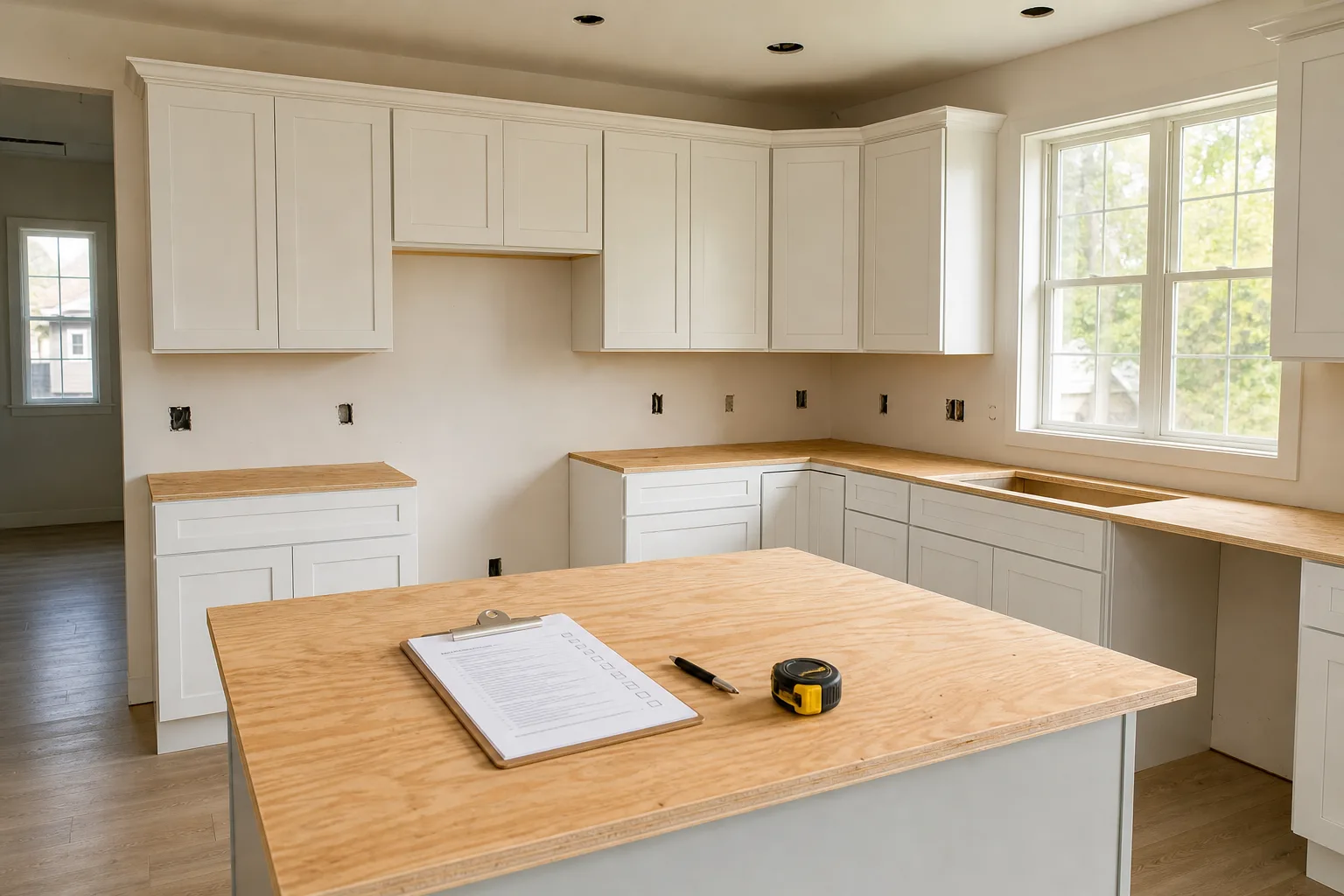
On a California remodel, your payments should follow finished work. CSLB, the state contractor board, says payments "cannot exceed the value of the performed work." Alongside each payment, you should collect lien releases, because unpaid subs and suppliers can put a lien on your home even after you paid your contractor in full.
This guide is about the money, start to finish. It covers how a payment schedule maps to a kitchen or bath, how the lien system works, which release form to ask for and when, what to do if a notice shows up, and how to hold back the last payment until the job is really done.
The rule: pay for work that is done
CSLB's consumer guide: "A home improvement contract must include a payment schedule. It should show the amount of each payment and explain what work, materials or services are to be performed for that particular payment. Payments to the contractor cannot exceed the value of the performed work." CSLB's regulation text adds that each progress payment "must not exceed the value of the amount of work (labor and materials) that has been incorporated into each phase." (CSLB guide; CSLB written statement, 16 CCR 858.2)
CSLB's checklist boils it down: "Only pay as work is completed, not before."
The short recap. The contract has to carry the agreed price, and any change goes through a signed change order. The down payment is capped: "$1,000 or 10 percent of the contract price, whichever is less," with a narrow exception for a handful of licensees with a blanket performance and payment bond on file. We cover the contract, the cap and change orders in what a fixed-price remodel quote means in California. This guide picks up after you sign.
What a milestone looks like on a kitchen or bath
CSLB does not publish a list of phases. The contract has to say what work each payment covers. Here is our plain-English example of how finished phases can map to payments. It is a way to think about it, not a CSLB form and not a promise about any contractor's schedule.
Kitchen
- Demo and disposal. The old cabinets, counters and flooring are out and hauled away.
- Rough-in passed inspection. Plumbing and electrical changes are in, and the city inspector has signed off where a permit applies.
- Drywall. Walls and ceiling closed, taped and finished.
- Cabinets installed. You can open the doors and check the fit.
- Counters installed. Cut, set and sealed.
- Final. Tile, fixtures and trim are finished, and the punch list is done.
Bath
- Demo and disposal. Fixtures, tile and old surfaces are out.
- Rough-in passed inspection. Drain, supply and electrical work is in place and inspected where a permit applies.
- Drywall or backer board. The wet-area walls are ready for tile.
- Tile set and grouted. You can see the shower or tub surround as it will be.
- Vanity, fixtures and glass installed.
- Final. Punch list done.
Notice the test: each line is something you can walk in and see. Do not pay on a date. Pay on a phase. If you are not sure whether a phase is finished, ask your contractor to walk it with you before the payment comes due.
Which of these steps need a city permit depends on your city. See do you need a permit to remodel in the SGV?
What this means for your project
A payment schedule that follows finished work is in every Dollhouse written quote. Ask Dallas to walk you through it line by line.
CSLB #1045801 · 4.6 from 19 Google reviews · Dallas answers the phone
How the mechanics lien system works
CSLB says a mechanics lien is "a 'hold' against your property." It is recorded with the county recorder's office, and it is "filed by an unpaid contractor, subcontractor, laborer, or material supplier." If a lien goes unpaid, "it allows a foreclosure action, forcing the sale of the property in lieu of compensation." CSLB is blunt about who carries the risk: "Legally, the homeowner is ultimately responsible for payment," even if the owner already paid the direct contractor. (CSLB, What is a mechanics lien?)
CSLB's guide: "A property owner could be forced to pay twice or have the court sell the home to pay the lien. Liens also can affect a consumer's personal credit rating, and affect their ability to borrow and refinance."
The warning in your contract
CSLB says "Contractors are required to give consumers a 'Mechanics Lien Warning.'" It is part of the contract (CSLB guide, citing Business and Professions Code 7159). Ask for it before you sign. If your contract does not have one, ask why.
The preliminary notice
CSLB: "A Preliminary Notice is required from subcontractors and suppliers if there is a chance they may need to file a lien." The guide says subs and suppliers must give the owner that notice "within 20 days of delivering products/materials or 20 days of beginning the work." CSLB's lien page adds that a notice "may be given after those 20 days," but "payment only is required for work done 20 days before the notice is delivered." (CSLB guide; CSLB, How to prevent a mechanics lien)
Who has to send one? Civil Code 8200 lists the owner, the direct contractor, and the construction lender if there is one. A laborer is not required to give one, and a company with a direct contract with the owner needs to notify only the construction lender, if any. (Civil Code 8200)
Deadlines to record a lien
A direct contractor may not enforce a lien unless the claim is recorded before the earlier of "ninety days after completion of the work of improvement" or "sixty days after the owner records a notice of completion or cessation." For other claimants, the outer limits are ninety days after completion or thirty days after the owner records a notice of completion or cessation. (Civil Code 8412 and 8414, as shown on a mirror of the code; confirm current text before relying on these dates.) Whether to record a notice of completion is a question for your attorney or title company.
Lien releases: ask for them with every payment
A lien release is a signed form in which the person who did the work gives up lien rights for the amount covered. California's Civil Code sets out four forms, and says a release is "null, void, and unenforceable unless it is in substantially the following form" (Civil Code 8132 to 8138). Here is the set:
- Conditional waiver and release on progress payment (Civil Code 8132). The form says it "is effective only on the claimant's receipt of payment." Its notice: "A PERSON SHOULD NOT RELY ON THIS DOCUMENT UNLESS SATISFIED THAT THE CLAIMANT HAS RECEIVED PAYMENT." You get this one before you pay.
- Unconditional waiver and release on progress payment (Civil Code 8134). The notice to the signer: "THIS DOCUMENT IS ENFORCEABLE AGAINST YOU IF YOU SIGN IT, EVEN IF YOU HAVE NOT BEEN PAID." You get this one after the payment clears.
- Conditional waiver and release on final payment (Civil Code 8136). Same conditional wording, for the last payment.
- Unconditional waiver and release on final payment (Civil Code 8138). Same unconditional wording, once the last payment is made.
The routine
- A payment comes due on a finished phase.
- Before you pay, get a signed conditional release. CSLB: "Before making a payment, get a signed conditional release from the possible lien claimants."
- Pay.
- After you pay, get the unconditional release. CSLB: "After you pay, the contractor should provide you with an unconditional release."
- Keep both with your contract. CSLB says that "By law, you may withhold the next payment until you get the unconditional releases for the previous payment." (CSLB, How to prevent a mechanics lien)
The forms are written for each claimant: your contractor, and the subs and suppliers who worked under them. CSLB's guide says "Have subcontractors sign lien releases when their portion of the work is completed." Also ask your contractor for a list of every sub and supplier, with start and finish dates. CSLB suggests that list too. CSLB adds one more option: "The simplest way to prevent liens and ensure that subcontractors and suppliers are paid is to pay with joint checks," payable to both the contractor and the supplier or subcontractor.
What to do if a sub or supplier sends a notice
Do not panic. A preliminary notice is not a lien. It is a notice that this company has the right to file one if it is not paid. CSLB says these notices are required from subs and suppliers who may need to file a lien, so one showing up is routine. Treat it as a prompt to check the paperwork.
- Keep it. Put it with your contract and payment records, with the date you got it.
- Check the list. Is this company on the sub and supplier list you asked for? If not, ask your contractor who they are.
- Ask in writing. Email your contractor: has this company been paid for its work to date? Ask for a conditional release from it before your next payment.
- Hold the next payment until you have the unconditional release for the last one. CSLB says the law lets you.
- Consider a joint check for the next payment that covers this company's work.
- If a lien is actually recorded, call a California attorney. CSLB's lien page says to "seek legal assistance." We could not open CSLB's page on what to do after a lien is recorded, so we do not give steps for that here.
- A contractor who will not provide releases. Ask why before you pay the next draw.
- A request for payment ahead of finished work. CSLB: payments "cannot exceed the value of the performed work."
- A release you have not read. An unconditional release is binding the moment it is signed.
The final payment, the punch list and holding back
CSLB's guide says nothing specific about a "retention" amount or a punch list, and we did not find a CSLB rule on it, so what follows is our plain-English advice, not a CSLB requirement.
- Walk the whole job with your contractor and write a punch list: chips, gaps, touch-up paint, a drawer that rubs, a missing cover plate.
- Tie the last payment to the finished list, and put that in the payment schedule at signing. The final line should say what "final" means.
- Where a permit applies, wait for the final inspection sign-off before the last payment.
- Get the final releases. Ask for the conditional final release (Civil Code 8136) before you pay, and the unconditional final release (Civil Code 8138) after.
- Collect the paper. Warranties your contract promised, manuals, and the final sub and supplier releases.
CSLB also says that if you are promised something verbally, make sure it is "also included in writing." The punch list is the place to do that.
Check, card or cash, and the three-day cancel right
How to pay. The CSLB pages we read do not say how you must pay, and they do not mention cash. Our advice: pay in a way that leaves a record, such as a check with the project and phase on the memo line, and get a written receipt each time. Keep every release with the payment it matches. If you want to pay by credit card, ask the contractor first, since fees and terms vary. CSLB's one payment-method tip is the joint check, covered above.
The three-day cancel right. CSLB's guide says the buyer gets "three (3) business days (or five business days if the buyer is 65 or older)" to cancel. You give written notice. The contractor must return any money paid within 10 days of receiving the request. The right does not apply "if the contract is negotiated at the contractor's place of business." (CSLB guide)
How Dollhouse handles payments
Short, because the rules above apply to us too.
- Your quote is written and fixed. The payment schedule is in the contract.
- The down payment stays within the legal cap.
- Every later payment follows finished work you can see.
- Changes happen in writing, with your OK first.
The full version is on how we work. Our license number is CSLB #1045801. You can check any contractor's license, ours or someone else's, with our guide to checking a California contractor license. When you are ready, get a written, fixed-price quote or call Dallas at (626) 991-8219.
Questions we get
Do I have to pay the contractor in full before the job is done?
No. CSLB's guide says a home improvement contract must include a payment schedule and that "Payments to the contractor cannot exceed the value of the performed work." Its checklist says: "Only pay as work is completed, not before."
Can I still get a lien if I paid my contractor in full?
Yes. CSLB's guide: "Even if the contractor is paid in full, unpaid subcontractors, suppliers, and laborers involved in the project may record a mechanics lien and sue the property owner in court to foreclose the lien." That is why lien releases and joint checks exist.
What is the difference between a conditional and an unconditional release?
A conditional release is effective only when the person signing receives the payment. An unconditional release is effective when signed, even if the person has not been paid. So you get a conditional one before you pay, and an unconditional one after the payment clears.
What if a supplier or sub sends me a preliminary notice?
It is a notice of their right to file a lien, not a lien. CSLB says it is required from subs and suppliers if there is a chance they may need to file one. Ask your contractor in writing whether that company has been paid, and ask for a release before your next payment.
Can I cancel after I sign?
Often. CSLB's guide gives three business days (five if you are 65 or older) to cancel by written notice, with money returned within 10 days. It does not apply if the contract was negotiated at the contractor's place of business.
Note: general background on payments and liens, not legal advice. Rules change; confirm with CSLB or a California attorney before you sign or pay.
Sources
All pages opened and read November 13, 2026. Rules change. Confirm with CSLB or a California attorney before you sign or pay.
Every source, with the date we read it
CSLB, the state contractor board
- A Consumer Guide to Home Improvement Contracts (PDF): https://www.cslb.ca.gov/resources/GuidesAndPublications/HomeImprovementContractsConsumerGuide.pdf (read November 13, 2026)
- Understanding Mechanics Liens (landing page: introductions only): https://www.cslb.ca.gov/Consumers/Legal_Issues_For_Consumers/Mechanics_Lien/ (read November 13, 2026)
- What is a mechanics lien?: https://www.cslb.ca.gov/Consumers/Legal_Issues_For_Consumers/Mechanics_Lien/What_Is_A_Mechanics_Lien.aspx (read November 13, 2026)
- How to prevent a mechanics lien: https://www.cslb.ca.gov/Consumers/Legal_Issues_For_Consumers/Mechanics_Lien/How_To_Prevent_A_Mechanics_Lien.aspx (read November 13, 2026)
- What is a Contract?: https://www.cslb.ca.gov/Consumers/Hire_A_Contractor/Home_Improvement_Contracts/What_Is_A_Contract.aspx (read November 13, 2026)
- What Should I Look for in a Contract and Binding Agreements?: https://www.cslb.ca.gov/consumers/hire_a_contractor/Contracts_And_Binding_Agreements.aspx (read November 13, 2026)
- Written statement on home improvement contract requirements (16 CCR 858.2 text, PDF): https://www.cslb.ca.gov/Resources/LawsAndRegulations/2022/CCR858.2Sec100WrittenStatement2022_09.pdf (read November 13, 2026)
California Civil Code (read on the california.public.law mirror, because leginfo.legislature.ca.gov refused automated requests; confirm against leginfo)
- Civil Code 8132, conditional waiver and release on progress payment: https://california.public.law/codes/ca_civ_code_section_8132 (read November 13, 2026)
- Civil Code 8134, unconditional waiver and release on progress payment: https://california.public.law/codes/ca_civ_code_section_8134 (read November 13, 2026)
- Civil Code 8136, conditional waiver and release on final payment: https://california.public.law/codes/ca_civ_code_section_8136 (read November 13, 2026)
- Civil Code 8138, unconditional waiver and release on final payment: https://california.public.law/codes/ca_civ_code_section_8138 (read November 13, 2026)
- Civil Code 8200, who must receive a preliminary notice: https://california.public.law/codes/ca_civ_code_section_8200 (read November 13, 2026)
- Civil Code 8412, direct contractor lien deadline: https://california.public.law/codes/ca_civ_code_section_8412 (read November 13, 2026)
- Civil Code 8414, other claimants lien deadline: https://california.public.law/codes/ca_civ_code_section_8414 (read November 13, 2026)