
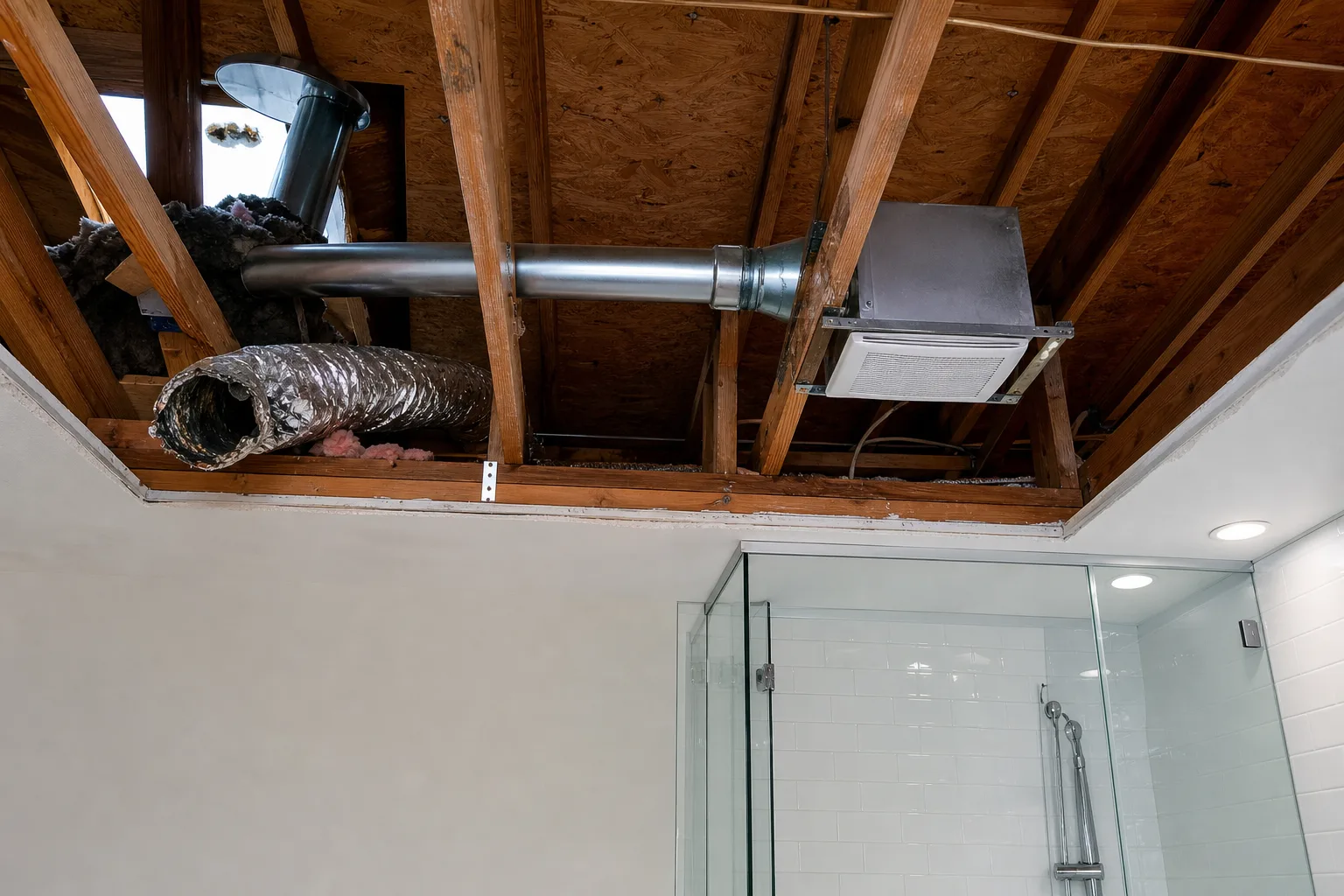
In California, a bathroom needs a fan that vents to the outdoors. The Energy Code says so, and a window does not stand in for it. The state's compliance form lists 50 cfm for a fan you switch on and 20 cfm for one that runs all the time. A fan that dumps its air into the attic, or one with a crushed duct, misses the point of the rule even if it spins.
The reason is moisture. EPA puts it in one line: "The key to mold control is moisture control." A shower puts a lot of water into the air. If it has nowhere to go, it lands on the ceiling, the walls and the grout.
What California's code asks for
The rule. The Energy Commission's summary of the mandatory measures says all dwelling units "shall meet the requirements of ASHRAE Standard 62.2, Ventilation and Acceptable Indoor Air Quality in Residential Buildings," as amended in Section 150.0(o)1. On exhaust it says: "Kitchens and bathrooms shall have local mechanical exhaust." (CEC mandatory measures summary)
Which kind. Enclosed bathrooms use either a demand-controlled fan, one that you or a sensor turn on, or a continuous exhaust fan. The installer measures the airflow, and the fan is rated for sound. (CEC mandatory measures summary)
What counts as a bathroom. The Energy Commission's 2019 compliance manual defines it as "any room containing a bathtub, shower, spa, or other similar source of moisture." A room with only a toilet does not need its own fan. (CEC 2019 manual)
When it applies to a remodel. The 2025 compliance manual says whole-dwelling ventilation is required in new dwellings, new dwelling units added to a building, and additions of more than 1,000 square feet. It also says "alterations to components of existing buildings that previously met any requirements of ASHRAE 62.2 must continue to meet requirements upon completion of the alteration(s)." Whether a given remodel triggers the fan rule is a question for your city's plan check, and we do not guess at it here. If your plan adds or replaces a bath fan, plan on the numbers below. (CEC compliance manual, Chapter 4)
Airflow and sones: the two numbers on the box
- 50 cfm for a fan you switch on. The Energy Commission's compliance form lists "Bathroom 50 cfm" in its table of demand-controlled rates. (CEC form CF2R-MCH-32-H)
- 20 cfm for a fan that runs continuously. The same form lists "Bathroom 20 cfm" in its continuous table. (CEC form)
- Sound, in sones. Continuously operating local exhaust fans "must be rated at a maximum of 1.0 sone." Demand-controlled local exhaust fans "must be rated at a maximum of 3.0 sones." (CEC compliance manual, Chapter 4)
A sone is a loudness rating, and lower is quieter. We use it as a comfort guide. A fan that roars gets switched off, and a fan that is off dries nothing. HVI, the Home Ventilating Institute, keeps the Certified Products Directory where a model's ratings are listed. (HVI)
These are ratings at a set test pressure. What a fan moves in your house depends on the duct, which is the next section.
What this means for your project
If your fan dumps into the attic, a remodel is the time to fix it. Dallas can look at the duct and the roof cap before the quote is written.
CSLB #1045801 · 4.6 from 19 Google reviews · Dallas answers the phone
The duct and the outside vent matter as much as the fan
Outdoors, not the attic. The compliance manual: "Kitchens and bathrooms must have local exhaust systems vented to outdoors." Panasonic's install sheet is as plain: "Ducted fans must always be vented to the outdoors." (CEC compliance manual; Panasonic)
Duct size. The compliance form carries a duct-size table, Table 150.0-H. For a 50 cfm fan it lists 4 inches as the minimum diameter, rigid or flex, and for an 80 cfm fan it lists 5 inches for both. (CEC form CF2R-MCH-32-H) Panasonic's sheet for its WhisperCeiling DC series says "A 4 or 6 inch circular duct is needed," depending on the model. Read the sheet for the fan being installed.
Short, straight and sealed. Panasonic: "Use the shortest, straightest duct routing possible for best performance, and avoid installing the fan with smaller ducts than recommended." Its drawing shows a roof jack, wall cap or soffit vent "with backdraft damper," joints sealed with mastic or foil tape, and a 2 to 3 foot straight run before an elbow. It also says insulation around the ducts "can reduce energy loss and inhibit mold growth."
Existing ducts. Panasonic: "Fans installed with existing ducts may not achieve their rated air flow." That is why we look at the old duct before we reuse it.
Window or fan?
Both help, but only the fan counts. The compliance manual says Energy Commission field research found "many occupants do not open windows regularly for ventilation," and it says that opening and closing windows is not an allowable way to meet the dwelling-unit ventilation requirement. For the bathroom itself, the rule is a local exhaust system vented to outdoors. (CEC compliance manual, Chapter 4)
EPA's advice to residents: "Run the bathroom fan or open the window when showering." (EPA, A Brief Guide) Use the window on a dry day. Run the fan every time.
Why the old fan did nothing
Fans in older houses tend to fail in the same few ways, and you usually can't see any of them from the room. See also what can hide in a 1960s or '70s house.
- The duct ends in the attic. The air goes up and stops, and the moisture settles on the framing and insulation. The manufacturer's rule is that ducted fans vent outdoors. Our bathroom page lists a fan that vents into the attic among the things we may find in an old bath.
- The duct is too small, too long or crushed. Panasonic's sheet says not to install where ducts show "excessive bending," "successive bending" or a "squeezed duct." The fan hums, but little air leaves.
- The damper is stuck or missing. A backdraft damper lets air out and keeps outside air from blowing back in. Stuck shut, the fan has nowhere to push. Stuck open, outside air comes in.
- The grille and housing are clogged. Dust cuts airflow, and nobody cleans a fan they forgot was there.
- The fan is too weak for the room, or the switch is one nobody uses. A fan that is off does nothing.
Where mold starts, and the 24 to 48 hour line
EPA: "The key to mold control is moisture control." On wet materials, EPA's line is "It is important to dry water-damaged areas and items within 24-48 hours to prevent mold growth." (EPA, A Brief Guide; EPA, Mold and Health)
A shower is a small water event, every day. Mold tends to show first where surfaces stay damp longest: the ceiling over the shower, the corners and the caulk line. For damp areas that are hard to keep mold-free, EPA's cleanup page points to "increasing ventilation (running a fan or opening a window) and cleaning more frequently." (EPA, Mold Cleanup in Your Home)
The Energy Commission makes the same link: "Moisture condensation on indoor surfaces is a leading cause of mold and mildew in buildings." (CEC 2019 manual)
A leak is different from steam. Water behind the tile is a repair, not a ventilation problem. For how a wet area is rebuilt, see tub-to-shower conversions.
What a remodel fixes
A bath remodel is the time the ceiling and walls are open. That is when ventilation can be done right instead of patched.
- A fan sized and rated for the room. Check the cfm and sone ratings on the label against the numbers above.
- A duct that fits the fan. The right diameter, as short and straight as the framing allows, with sealed joints.
- An outside termination with a backdraft damper. Roof jack, wall cap or soffit vent. Not the attic.
- A control people will use. The code only requires that there is a control. A timer or a humidity-sensing switch keeps the fan running after you leave, while the steam is still in the room.
- A look at the old duct. If it is damaged, undersized or too long, it comes out.
Paint and grout play a smaller part. Bath paint and sealed grout are easier to wipe clean, but they do not move moisture out of the room. The fan does.
What a bath job covers: bathroom remodeling. Energy-code rules more broadly: Title 24 energy rules for a remodel. If a fan and duct are part of your job, they belong in your written quote, and the schedule is in the quote too.
Permits: adding or moving a fan
A new fan in a new spot usually means a new switch, new wiring and a new duct through the roof or wall. Cities draw the line differently, so ask yours. What the city pages say:
- Claremont: cosmetic work such as painting, cabinets and interior trim does not need a permit, but plumbing work, new circuits and wall or window changes do. (city page, read November 8, 2026)
- San Dimas: moved plumbing or electrical, walls and windows need a permit. (city page, read November 8, 2026)
- Covina: Handout #01 says "remodels, alterations, and repairs" need a permit. A bath remodel over $1,000 also triggers a smoke and CO alarm upgrade under Handout #09. (city page, read November 8, 2026)
- West Covina: "Most any work done to your home requires a permit." (city page, read November 8, 2026)
- Azusa: a permit is required when a structure is "erected, constructed, enlarged, altered." (city page, read November 8, 2026)
- Glendora and La Verne: see our Glendora and La Verne permit notes.
We pull the permits for the jobs we build. The full city-by-city read is do you need a permit to remodel in the SGV?
Get a written, fixed-price quote or call Dallas at (626) 991-8219.
Questions we get
How big a fan does a bathroom need in California?
The Energy Commission's compliance form lists 50 cfm for a bathroom fan you switch on and 20 cfm for one that runs continuously. Those are minimums. A bigger room or a long duct run may call for a stronger fan, and the fan's label tells you what it moves.
Does the code require a humidity sensor?
Not by name, in the Energy Commission pages we read. Its compliance manual says "The only requirement is that there is a control," and that the control can be a manual switch or an automatic one such as an occupancy sensor. A humidity sensor or a delay-off timer is a choice, and a good one for a shower used every day.
Can an open window replace the fan?
Not for the code. The Energy Commission says bathrooms "must have local exhaust systems vented to outdoors." A window still helps, and EPA says to "run the bathroom fan or open the window when showering." Treat the window as a bonus, not the plan.
Why does my fan run but the mirror still fogs?
The fan may be moving very little air. Panasonic's install sheet says the duct "has a strong effect on the air flow, noise and energy use," and that fans installed with existing ducts "may not achieve their rated air flow." A small, crushed, long or disconnected duct is the usual cause, and you can't see it from the room.
Do I need a permit to add or replace a bathroom fan?
It depends on the city and on what changes. A new fan usually means a new switch, wiring and a duct to the outside, which is the kind of work cities list. Dallas will tell you whether yours needs one, and we pull permits for the jobs we build.
Note: general background, not legal advice. Codes change and cities enforce them their own way; confirm with your city's building department before you plan work.
Sources
All pages opened and read November 13, 2026. City permit lines reuse pages read November 8, 2026. Rules change. Confirm with your city before you plan work.
Every source, with the date we read it
Energy code and ventilation standard
- California Energy Commission, 2025 Single-Family Residential Mandatory Requirements Summary (PDF): https://www.energy.ca.gov/sites/default/files/2025-04/2025_Residential_Mandatory_Measures_Summary_ADA.pdf (read November 13, 2026)
- California Energy Commission, 2025 Single-Family Residential Compliance Manual, Chapter 4 (PDF): https://www.energy.ca.gov/filebrowser/download/8636?fid=8636 (read November 13, 2026)
- California Energy Commission, CEC-CF2R-MCH-32-H, Local Mechanical Exhaust, 2022 Residential Compliance form (PDF): https://www.energy.ca.gov/filebrowser/download/4739 (read November 13, 2026)
- California Energy Commission, Compliance Manual, Chapter 4, Mechanical Systems (PDF; the copy at this link is the 2019 Nonresidential manual, used only for its quoted ASHRAE 62.2 text and bathroom definition): https://www.energy.ca.gov/sites/default/files/2025-07/04_MechanicalSystems_ada.pdf (read November 13, 2026)
Mold and moisture
- EPA, A Brief Guide to Mold, Moisture and Your Home: https://www.epa.gov/mold/brief-guide-mold-moisture-and-your-home (read November 13, 2026)
- EPA, Mold Cleanup in Your Home: https://www.epa.gov/mold/mold-cleanup-your-home (read November 13, 2026)
- EPA, Mold and Health: https://www.epa.gov/mold/mold-resources (read November 13, 2026)
Fan maker and fan ratings
- Panasonic, WhisperCeiling DC series installation instructions (PDF): na.panasonic.ca, WhisperCeilingDC_series_Installation_en.pdf (read November 13, 2026)
- Home Ventilating Institute (HVI), home page, which lists the Certified Products Directory and a video on sones: https://www.hvi.org/ (read November 13, 2026)
City permit pages
- City of Claremont, When do I need a permit?: https://www.claremontca.gov/Business-Development/Building-and-Construction/Building-Permits-and-Plan-Checks/When-do-I-need-a-permit (read November 13, 2026)
- City of Covina, Building Safety, Apply for a Permit: https://covinaca.gov/city-departments/community-development/building-safety/building-safety-apply-for-a-permit/ (read November 13, 2026)
- City of West Covina, Building Division: https://www.westcovina.gov/228/Building-Division (read November 13, 2026)
- City of Azusa, Building Permits: https://azusaca.gov/117/Building-Permits (read November 13, 2026)