
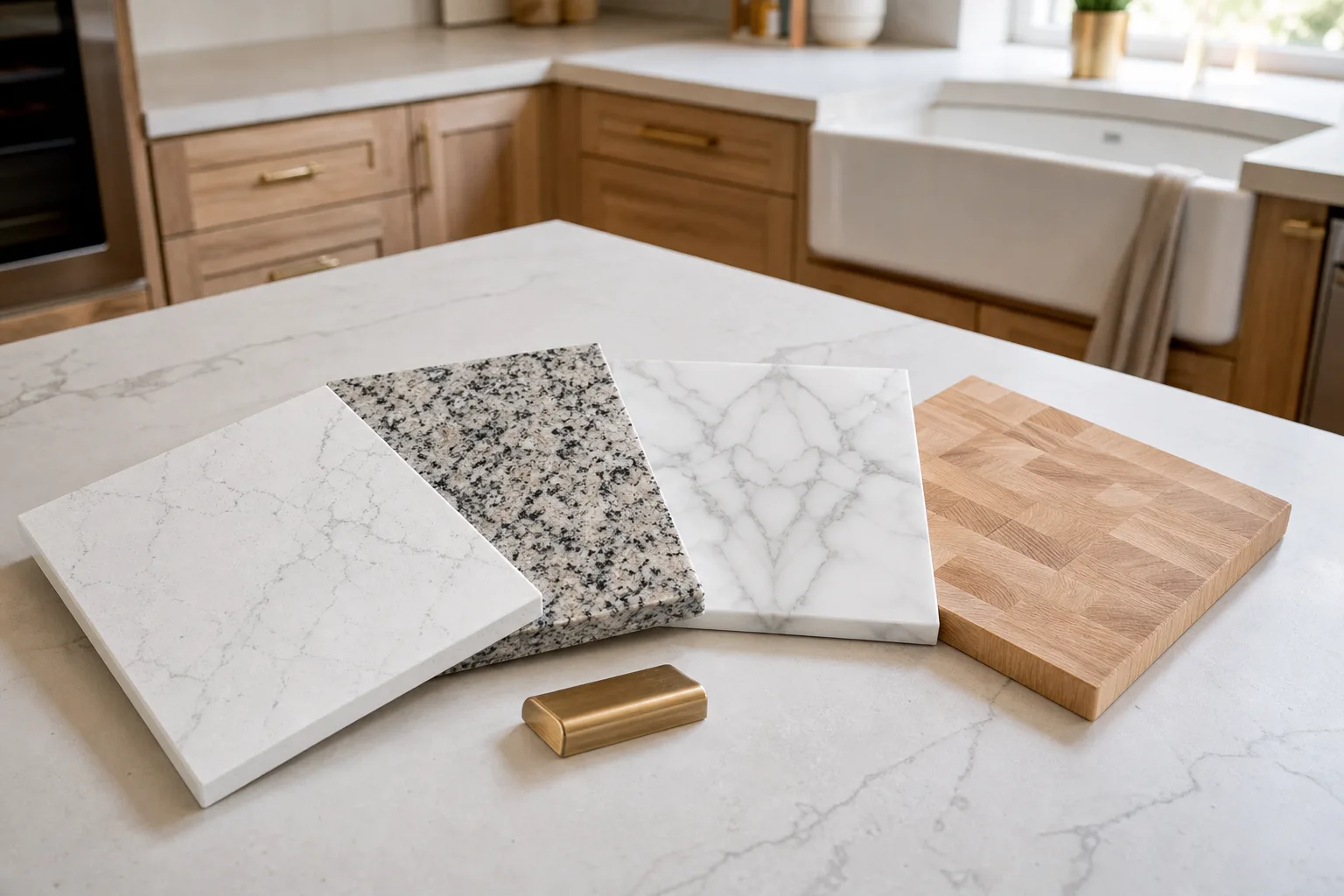
There is no best countertop. There is the one whose weak spot you can live with. Quartz is even and low upkeep, but its maker still says use a trivet. Granite is natural and each slab differs, and it can crack from localized heat. Porcelain slab is very hard and thin, and thin changes how an island is supported. Butcher block is warm and needs oil on a schedule.
This guide goes through care, heat, stains, seams, edges, island overhangs, sinks and the order of events from measuring to install. It also covers the safety issue behind every stone countertop: silica dust. That is a fabrication-shop issue, not a kitchen issue, and the California rules for it changed in 2023 and 2025 and are moving again in 2026.
We name the source for every rule. Where a "fact" is a manufacturer's claim, we say so. We do not list prices on this site. For what moves a kitchen number, see the cost guide.
Care, heat and stains, material by material
Short version of each, with who said it.
Quartz (engineered stone)
- Sealing. Cambria: "Our quartz countertops never require sealing, polishing, or reconditioning and are stain resistant." (Manufacturer claim.)
- Heat. Cambria: "Cambria is not heat-proof, chemical-proof, or fracture-proof in any form." It recommends "a closed-weave hot pad or solid trivet such as a breadboard under pots and pans." (Manufacturer.)
- Cleaning. "Just use a little warm water, soft cotton cloth, and mild soap, if desired." Cambria also says markings "are more visible on monotone designs than multicolored surfaces." (Manufacturer.)
Granite and other natural stone
- Sealing. Natural Stone Institute (NSI): "Most granite countertops do not need to be sealed." For marble and granite it says "in many cases it makes sense" to seal with a quality sealer. A sealer makes stone "more resistant," not stain-proof. NSI's sealer page says the product "should have a life expectancy of ten to fifteen years."
- Heat. NSI: "Granite is typically heat resistant up to temperatures of ±250°C (±480°F)," but "direct application of localized heat sources is discouraged, since strong thermal gradients within the stone can initiate cracking."
- Acids. NSI: "Products containing lemon, vinegar or other acids may dull or etch calcareous stones." On marble: "The calcite crystal is vulnerable to attack by mild acids, including those commonly found in kitchen and bar settings." NSI says to clean with "a neutral cleaner, stone soap, or a mild liquid dishwashing detergent and warm water," and to use coasters under glasses.
Porcelain slab (Dekton, Laminam and similar)
- Heat. Cosentino's use-and-care guide says pans "can be placed directly on the work surface after use," with a footnote: "For Dekton 8 mm, it is necessary to use protection against hot objects." Laminam says its surface "is not altered in case of direct contact with very hot items in the kitchen." Its data sheet rates dry heat resistance "5 (no visible effect till 200°C)." (Both manufacturer claims.)
- Stains. Cosentino: "Due to its low porosity, Dekton is a surface that is highly resistant to common household stains." (Manufacturer.)
- Cautions. Cosentino says to avoid "direct cutting on the surface with ceramic knives" and "the use of sponges made from metal or with abrasive particles."
Butcher block (wood)
- Oil. Boos: "A minimum of once a month (depending upon use and household conditions), apply an even coat of Boos Block Mystery Oil," and a dry appearance means it is time to oil again. (A maker's care instruction for its own product.)
- Water. Boos: "DO NOT allow fresh, wet meats and liquids of any type to stand on the countertop surface for long periods of time." Moisture can soften the wood and weaken glued joints.
- Heat. The Boos care page does not address hot cookware. Not found in our research, so use a trivet.
Seams and edges
Seams. Slabs have a maximum size, so a long counter or an L-shape may need a joint. Where it goes is a design choice. Cosentino's guide says it "does not recommend leaving joints in the cut-out area" around a sink or cooktop. If one is needed, it gives a minimum distance from the cut-out to the joint: 150 mm (6") for Dekton 12 mm and 100 mm (4") for Dekton 20 mm. (A manufacturer's rule for its own product.)
Ask to see the seam layout on a drawing before the slab is cut. A seam that lands in the middle of a sink run is easier to move on paper.
Edges. The profile, such as flat, rounded or beveled, is a look-and-wear choice made with your fabricator. Cosentino says to avoid knocks "in areas which are more exposed (corners, edges, bevels, etc.)," and recommends that cut-out edges "be slightly chamfered." We did not find a neutral source ranking edge profiles, so we do not rank them. Hold a sample edge in your hand.
What this means for your project
The counter is chosen after the cabinets and the sink, because they decide the overhang, the seams and the cutouts. Dallas can walk the island with you.
CSLB #1045801 · 4.6 from 19 Google reviews · Dallas answers the phone
Islands: how far can a countertop overhang?
A seating overhang is the part of the top with nothing under it. The limit depends on the material and its thickness.
- Granite. CTaSC, quoting the NSI Dimension Stone Design Manual: "a 1.25″ thick stone can have a 3′ unsupported span," and the cantilever "should be limited to a 10″." For 3/4" (2 cm) stone the page gives 6". The author says these are "recommendations," not a mandatory standard, and that "it is always a good idea to support the cantilevered stone with corbelled supports." (Secondhand: we could not open the NSI manual.)
- Dekton. Cosentino's guide lists a long-side island overhang, with no cut-out, of 300 mm (12") for 12 mm and 600 mm (24") for 20 mm. It also lists a "Maximum concentrated static load" of 100 kg (220 lb). (Manufacturer.)
- Laminam. Its guide suggests a maximum protruding part of 350 mm for 12+ and 450 mm for 20+, and says to anchor the countertops to the bases so the lever effect does not cause "crazing." (Manufacturer.)
Three sources, three different numbers. That is the point. Overhang limits depend on the product, the thickness, what is under it and the load. A seating overhang is where people lean and sit, so the support detail belongs on the drawing, not on install day. For how a layout change affects the plan, see layout change vs. same footprint.
Sinks: undermount vs drop-in
A drop-in (top-mounted) sink has a rim that sits on the counter. An undermount hangs below, so the counter edge at the hole is exposed and has to be finished. Cosentino's guide gives different edge and fixing rules for each: for undermount sinks, a "Polished flat, rounded" edge at the cut-out, fixed with adhesive, a plate or anchors; for top-mounted, an "Unpolished flat" edge. It also says inside corners of a cut-out need "a minimum radius of 10 mm [3/8"]." (Manufacturer, for Dekton.)
- Drop-in. The rim hides the cut edge. It leaves a lip where crumbs collect.
- Undermount. You can wipe straight into the sink. The cut edge is visible and needs a good finish, and the top around the hole needs support.
- Butcher block. Wood and standing water do not mix (see Boos above). Ask how the sink cut-out is sealed.
Choose the sink before the template visit. The cut-out is made to the sink's actual dimensions.
From template to install: the order
Slab counters are not measured at the start. They are measured after the cabinets are in. Cosentino: before detailed measurements, "check that all cabinets are installed, properly leveled, in their final position."
- Cabinets set and leveled. See cabinet options.
- Pick the slab. For natural stone, look at the actual slab, not a small sample. Each slab differs.
- Template. The fabricator measures the cabinets as they sit, with the sink and cooktop chosen.
- Fabrication at the shop. Cutting, edge work and cut-outs happen here. See the next section.
- Install. The finished top is set on the cabinets, seams closed, sink fitted.
That second trip is built into the plan. The schedule is in your written quote. Why a kitchen takes the time it does: how long a remodel takes.
Silica dust: why countertops are cut at a shop
Cutting, grinding and polishing stone makes respirable crystalline silica dust. Breathing it causes silicosis. This is the one safety topic in this guide that is not a matter of taste.
What the health agencies say
- Silica content. CDC: "Engineered stone contains substantially more silica than does natural stone (>90%, compared with <45% in granite)." (CDC MMWR)
- Cases. "Eighteen cases of silicosis, including two fatalities, are reported among stone fabrication workers in four states." (MMWR, 2019.) One case involved "polishing slabs and dry-cutting and grinding stone edges."
- What works. NIOSH: "Engineering controls such as wet methods and ventilation should be used to control exposure to dust." Respiratory protection is described as the least effective control. (NIOSH bulletin)
- Cal/OSHA. "Silica exposures from artificial stone (also called engineered stone) are much more toxic and dangerous," and "uncontrolled artificial stone fabrication presents a significant and immediate health hazard." (Cal/OSHA silica page)
What California requires of fabricators
- Timeline. The Standards Board approved an emergency temporary silica standard in December 2023, then approved permanent changes to Title 8 section 5204 on February 5, 2025. (DIR news release 2026-45; Cal/OSHA fact sheet.) You may see "2024" cited for the emergency rule. We read only the dates on these two pages and use them.
- Trigger tasks. Cutting, grinding, polishing and cleanup on artificial stone with more than 0.1% crystalline silica by weight, or other materials such as natural stone above 10%, are "high-exposure trigger tasks." (Section 5204(b)(8); fact sheet)
- Wet methods. "Effective wet methods that reduce exposure levels below the action level shall be used." (Section 5204(f)(2)(A)) The fact sheet describes a "constant flow of water that fully covers the contact area," submerging the work, or water-jet cutting.
- No dry cleanup. Compressed air and "any dry sweeping, shoveling, disturbing, or other dry clean-up" are prohibited for these tasks. (Section 5204(f)(2)(D))
- Controlled area and respirators. Tasks are done in "regulated areas identified by warning signs," and workers get powered air-purifying respirators or equal protection. (Fact sheet)
- Training attestation. From July 1, 2026, employers must submit an annual attestation to Cal/OSHA that these workers were trained. (Fact sheet)
Where it is heading
On May 22, 2026, the Standards Board "voted to grant a petition initiating the process to prohibit the fabrication and installation of artificial stone products containing more than 1% crystalline silica." (DIR news release 2026-45.) Cal/OSHA's advisory page lists draft language for a new section 5204.1 posted September 16 and October 22, 2026. It does not say a rule has been adopted. We have not seen final text, so we make no claim about what a final rule will say or when.
What this means for your kitchen
Our reading, not a regulation: wet cutting, a marked-off area, dust control and respirators are shop controls. A kitchen has none of them, and the dust lands where you cook. The fact sheet also says its changes do not apply to "construction work covered under section 1532.3." We did not read that section, so ask your fabricator how any on-site work is handled.
- Cutting or grinding a slab in your driveway or kitchen. Ask where fabrication happens. A shop is the expected answer.
- Dry cutting. Cal/OSHA requires wet methods for these tasks at work.
- "Porcelain is dust-free." Section 5204 says "Fired ceramic and porcelain tiles and panels are not artificial stone." But Laminam's own guide says "when Laminam slabs are being transformed, crystalline silica and glass fibres are released into the air." Ask the same dust-control questions.
Cal/OSHA's silica page is written for employers and workers and does not address installation work or homeowners. For questions about your own exposure, call Cal/OSHA or your doctor.
Do countertops need a permit?
It depends on the city. These are the readings already on our service pages (read November 8, 2026). San Dimas treats cabinets and counters as cosmetic. Glendora lists base cabinets and countertops on its permit list. Claremont lists cabinets as cosmetic. La Verne has no published list, and the state Residential Code baseline exempts "cabinets, counter tops and similar finish work." A moved sink or new circuit is a different story in every city. See what each city says.
Questions to ask any fabricator
- "Where do you cut and polish, and how do you control dust?" Wet methods and a shop are the expected answers.
- "What is the silica content of this material?" Ask for the manufacturer's data sheet.
- "Where do the seams go?" Get a drawing.
- "How is the island overhang supported?" Ask for the bracket or corbel detail and the product's limit.
- "Which sink type, and who supplies it?" The cut-out depends on it.
- "What care does the maker require?" Some warranties depend on cleaning and oiling.
Our own quote is written, itemized and fixed. See what a fixed-price quote must include and the kitchen remodeling page. Get a written, fixed-price quote or call Dallas at (626) 991-8219.
Questions we get
Does quartz need to be sealed?
Cambria says its quartz "never require[s] sealing, polishing, or reconditioning." That is a manufacturer claim. Natural stone is different. The Natural Stone Institute says "most granite countertops do not need to be sealed," and that sealing makes stone "more resistant," not stain-proof.
Can I set a hot pan on my countertop?
Use a trivet on every material. Cambria says its quartz "is not heat-proof." The Natural Stone Institute discourages localized heat on granite because it can crack the stone. Laminam and Cosentino say their porcelain handles hot cookware, with a caveat for thin Dekton 8 mm. Those are manufacturer claims.
Is it safe to have a countertop cut in my kitchen?
Ask where the cutting happens before you sign. Cal/OSHA requires wet methods for cutting engineered stone at work, and NIOSH says wet methods and ventilation are the main controls. A fabrication shop is set up for that. Your kitchen is not.
Is engineered stone banned in California?
Not as far as the sources we read say. In May 2026 the state Standards Board voted to start a process to prohibit fabrication and installation of artificial stone with more than 1% crystalline silica. As of November 13, 2026, Cal/OSHA's page shows drafts and advisory meetings, and does not say a ban has been adopted. Ask your fabricator what they are working with.
Why does the countertop go in after the cabinets?
The slab is made to fit the cabinets as they sit. Cosentino's guide says to check that "all cabinets are installed, properly leveled, in their final position" before detailed measuring. Your written quote has the schedule.
Note: general background, not legal or safety advice. Product claims below are the makers' claims, labeled as such. Rules change; confirm with Cal/OSHA and your city before relying on them.
Sources
All pages opened and read November 13, 2026. Rules change. Confirm with Cal/OSHA and your city.
Every source, with the date we read it
Silica and fabrication safety
- Cal/OSHA, Respirable Crystalline Silica Standards and Resources: https://www.dir.ca.gov/dosh/respiratory-silica-FAQ.html (read November 13, 2026)
- Cal/OSHA, General Industry Silica Standard: What Employers Need to Know (fact sheet, August 2026, PDF): https://www.dir.ca.gov/dosh/dosh_publications/General-Industry-Silica-Standard-Exec-Summary.pdf (read November 13, 2026)
- California Code of Regulations, Title 8, section 5204: https://www.dir.ca.gov/title8/5204.html (read November 13, 2026)
- DIR News Release 2026-45, "Standards Board Advances Efforts to Protect Workers from Silicosis," May 22, 2026: https://www.dir.ca.gov/DIRNews/2026/2026-45.html (read November 13, 2026)
- Cal/OSHA, Emergency Silica Advisory Committee page: https://www.dir.ca.gov/dosh/doshreg/silica-2026/ (read November 13, 2026)
- NIOSH, Outbreak of Silicosis among Engineered Stone Countertop Workers in Four States (2019): https://www.cdc.gov/niosh/bulletin/2019/silicosis-countertop.html (read November 13, 2026)
- CDC MMWR, Severe Silicosis in Engineered Stone Fabrication Workers, 2017 to 2019: https://www.cdc.gov/mmwr/volumes/68/wr/mm6838a1.htm (read November 13, 2026)
Natural stone
- Natural Stone Institute, Sealing Natural Stone Countertops: https://www.naturalstoneinstitute.org/consumers/sealing-stone/ (read November 13, 2026)
- Natural Stone Institute, Learn About Cleaning Products for Natural Stone: https://www.naturalstoneinstitute.org/consumers/care/ (read November 13, 2026)
- Natural Stone Institute, What Is Granite?: https://www.naturalstoneinstitute.org/consumers/varieties/granite/ (read November 13, 2026)
- Natural Stone Institute, Marble: https://www.naturalstoneinstitute.org/consumers/varieties/marble/ (read November 13, 2026)
- CTaSC, Maximum Cantilever Overhang of Natural Stone (a testing and consulting firm; the answer quotes the NSI Dimension Stone Design Manual, which we could not open): https://ctasc.com/expert-answers/maximum-cantilever-overhang-natural-stone-side-cabinet/ (read November 13, 2026)
Manufacturer pages (claims by the makers)
- Cambria, Quartz Product Care: https://www.cambriausa.com/quartz-countertops/product-care (read November 13, 2026)
- Cambria, Product Care FAQ: https://www.cambriausa.com/quartz-countertops/faq/product-care (read November 13, 2026)
- Cosentino, Dekton Countertops: Use & Care (PDF): https://assetstools.cosentino.com/api/v1/bynder/doc/996445C2-CE12-403B-9F60A63A5342031F/dekton-countertops-use-and-care-en.pdf (read November 13, 2026)
- Cosentino, Dekton Countertops: Design & Installation (PDF): assetstools.cosentino.com, dekton-countertops-design-installation-en.pdf (read November 13, 2026)
- Laminam, Technical guide for furnishing & design, 12+ and 20+ (PDF): https://www.laminam.com/wp-content/uploads/2023/09/technical-guide-for-furnishing-and-design-EN.pdf (read November 13, 2026)
- Boos Block, Care and Maintenance: Blocks: https://www.johnboos.com/care-and-maintenance/blocks (read November 13, 2026)