Many homes built in the 1960s and 70s have a 100-amp main panel. That was plenty when the biggest loads were a range, a dryer and a water heater. A new kitchen, a heat pump water heater, an EV charger or an ADU can use up the rest.
This post explains what adds load, how the load is figured, which older panels deserve a hard look, and what the upgrade involves. It is not a cost post, and we do not price panel work here. For the older-house picture, read remodeling a 1960s or 1970s home.
What in a remodel adds load to the panel?
Your panel feeds branch circuits. A project adds circuits, and each one counts toward the total the service has to carry. These are the usual additions in a kitchen or ADU job:
- Small-appliance circuits. Glendora's handout requires "at least two 20-ampere small appliance branch circuits for all receptacle outlets (including refrigeration equipment) in the kitchen, dining room, pantry, breakfast room." (Glendora, citing CEC 210.52(B)(1))
- Range or cooktop and wall oven. An electric or induction range is one of the largest loads in a house. Going from gas to electric adds a large 240-volt circuit that was not there before.
- Dishwasher, disposal, microwave. Each usually gets its own circuit, so each takes a breaker space.
- Heat pump water heater. The Energy Commission says it needs "a dedicated 240V branch circuit rated at 30-amp minimum" when the unit sits more than 3 feet from its receptacle, plus "a reserved space in the main electrical service panel for a double pole circuit breaker." (Energy Commission, 2025 single-family electric ready, Section 150.0(n))
- EV charger. Another 240-volt circuit, often a large one.
- ADU subpanel. A second dwelling is fed from the main service or its own service. See ADU utilities: panel, sewer and meter and ADU construction.
There are two limits, and you can hit either one. The first is capacity: how many amps the service and main breaker can carry. The second is space: whether the panel has empty slots, and whether it accepts the breaker types your new circuits need.
What this means for you. A kitchen that keeps gas appliances adds less load than one that goes all-electric. Decide that early. See kitchen remodeling and, if the range or sink is moving, kitchen layout change vs same footprint.
How is the load figured?
An electrician does not guess. Article 220 of the National Electrical Code, which California adopts as the California Electrical Code, gives two ways to add up a house. We could not read the code text for free, so this summary comes from EC&M, an electrical trade magazine. Check any number against your electrician's calculation.
EC&M: "The NEC provides two dwelling service load calculation methods: the standard method and the optional method." In plain words:
- Standard method. Counts the house by square footage, adds the small-appliance and laundry circuits at "1,500VA for each circuit," adds the big appliances, then applies demand factors.
- Optional method. Used only for a home fed by "a single 120/240V or 120/208V 3-wire set of service or feeder conductors" of 100 amps or more. EC&M says it "is usually faster and easier to apply."
- Demand factors. "Occupants don't use all loads simultaneously under normal living conditions," so the total is not a plain sum. For the optional method's general loads EC&M gives "100% of the first 10kVA, plus 40% of the remainder." Heating and air conditioning are counted separately.
An example, not your house. Say the general loads in some house add up to 20,000 volt-amperes (VA). The optional method counts the first 10,000 at 100% and the other 10,000 at 40%, so 14,000 VA. Service voltage is 240, so that is about 58 amps. Air conditioning, a heat pump or a water heater would be added on top. These numbers are invented to show the steps. Your house will differ.
What this means for you. The result is a number your electrician and the city can check. SCE's page says your assigned planner may follow up on a panel upgrade request, so expect questions. We did not find a free, official checklist of what a city wants, so ask your electrician what your city expects.
What this means for your project
Whether your panel has room is a question for the first visit, not the last week. Dallas looks at the panel and the appliance list before the quote is written.
CSLB #1045801 · 4.6 from 19 Google reviews · Dallas answers the phone
Which older panels deserve a hard look?
Age and inspection. The Consumer Product Safety Commission's Guide to Home Wiring Hazards (Publication 518) says an inspection is advisable if the last one was 40 or more years ago, and to use the age of the house as a guide if the panel has no date. It also says: "DO NOT remove the service-panel cover. This is a job for a qualified electrician."
Federal Pacific Electric (Stab-Lok). In 1983, CPSC closed an investigation "without making a determination as to the safety of FPE circuit breakers." It said the data "does not establish that the circuit breakers pose a serious risk of injury to consumers," and also that "Commission testing confirmed that these breakers fail certain UL calibration test requirements." It added that it "can reopen its investigation of FPE circuit breakers if further information warrants." (CPSC news release, 1983, read November 13, 2026.)
Zinsco. We found no government or utility source that rates Zinsco panels, so we say nothing about them beyond this: have a qualified electrician identify the panel and its breakers.
Overrated circuits. CPSC's guide lists panel problems such as fuses or breakers rated higher than the wire they protect. It says: "Do not put in a higher ampere fuse or circuit breaker."
- A breaker that keeps tripping. CPSC's 1983 advice: "Do not simply replace the fuse or reset the breaker." Find the cause.
- No empty slots, or breakers doubled up to fit. The new circuits may have nowhere to go.
- A panel nobody can identify. No label, no date, no brand you recognize.
What this means for you. A panel with a question mark is easier to deal with before walls close than after. Dallas walks the job first, and the panel is part of that look.
What does a service upgrade involve?
A service upgrade is more than swapping a box. The pieces are:
- A load calculation. It shows what service size the house needs.
- A meter spot request to SCE. SCE's building and renovation page lists "Panel upgrade (or meter spot) for an existing service connection" as its own request type. SCE decides where the meter and service connection go.
- The service equipment. The new panel, the meter base, and the way the power reaches the house, through a mast on the roof or an underground run. We did not find a free source that says which applies, so the utility's and the city's rules decide.
- Grounding. A new service has to be grounded correctly. We did not find a free source for the exact rule, so we leave the details to the electrician and the inspector.
- Protection on the new circuits. Glendora's handout says "Receptacles at kitchen countertop surfaces shall be protected with GFCI-AFCI [CEC 210.8(A)(6) & CEC 210.12(B)]." NFPA's tip sheet says "Arc-fault circuit interrupters (AFCIs) shut off electricity when a dangerous condition occurs." An older panel that cannot take the right breakers is a reason to look at replacement.
- Inspection. The city inspects the work. Who calls whom, and when SCE connects, is set by the city and SCE, so confirm it before you plan the power-off day.
The house may be without power while the old panel comes out and the new one goes in. Ask when, and for how long, and look for the schedule in your written quote.
Does a panel upgrade need a permit, and who calls SCE?
Yes. West Covina's Public Works FAQ asks "Do I need a permit to upgrade my electrical service?" and answers: "Yes. You will need to obtain an electrical permit before you start work," and you "need to contact Southern California Edison for a meter spot." It gives SCE's number as 800-655-4555. (West Covina FAQ, read November 13, 2026.)
We did not find the other cities publishing that exact question. Their pages put new, moved or altered electrical work on the permit side, and a service upgrade is that kind of work. We do not quote a city for a rule it does not state:
- San Dimas. Moved plumbing or electrical work needs a permit. San Dimas details.
- Glendora. Kitchen remodel permit list and electrical comments, quoted above. Glendora details.
- Claremont. New circuits are on the permit side of its cosmetic-or-not line. Claremont details.
- Covina. Handout #01 covers "remodels, alterations, and repairs." Covina details.
- West Covina. The service-upgrade FAQ above. West Covina details.
- Azusa. A permit is required when a structure is "erected, constructed, enlarged, altered." Azusa details.
- La Verne. We did not find a published list. La Verne details.
For how permits and inspections fit the rest of a project, see the SGV permit guide. We pull the permits on the jobs we build.
Can you avoid the upgrade?
Sometimes. SCE's Local Planning page says: "Options like load management, energy-efficient equipment, or design adjustments may support new electrical loads." Its cost program for panels under 100 amps requires applicants to confirm they have "evaluated all reasonable options to avoid service upsizing." (SCE, read November 13, 2026.)
West Light Energy, a California community energy agency, lists these options: "Smart load shedding or prioritization controllers," "Energy management relays," "Smart EV charging load-sharing systems," and smart electrical panels that coordinate when appliances run. It says a licensed electrician "can evaluate your panel and determine whether these solutions will work." The trade-off it names is that a device may pause an appliance, "sometimes temporarily, but only when your home is using a lot of power."
Another option you will see is a 240-volt splitter, which lets two appliances share one circuit. We did not find a government or utility page on splitters, so we claim nothing about them beyond their existence. Ask your electrician and your inspector whether one is acceptable for your project.
- These options may fit when the new loads are few, and a device can pause one of them without hurting you.
- An upgrade may fit better when you want an all-electric kitchen, an ADU, a charger and a heat pump on the same service, or when the old panel itself is the problem.
That is our plain reading, not a rule. Whichever you pick, the permit, the inspection and the written plan stay part of the job.
What to gather before you call
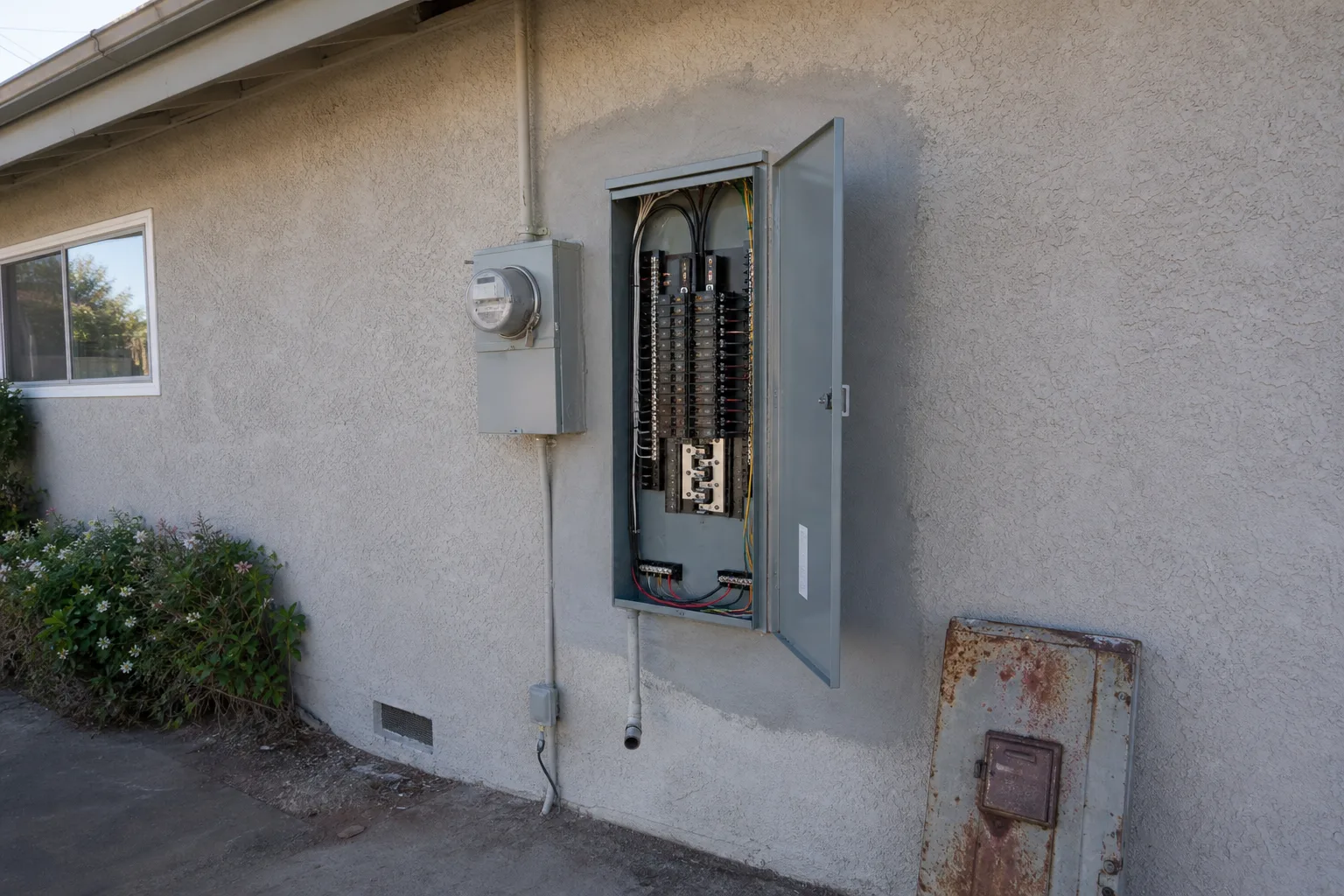
- A photo of the panel with the door open, and the main breaker label.
- A list of what you plan to add: range type, water heater, charger, ADU, air conditioning.
- Any past permits or electrical work you know about.
- Where the meter sits and whether the service comes in overhead or underground.
Then call. Dallas walks the house before anything is written, and the quote that follows is written, itemized and fixed. Changes go on a written change order. See how we work and the cost guide. Get a written, fixed-price quote or call Dallas at (626) 991-8219.
Questions we get
Does a kitchen remodel always need a panel upgrade?
No. It depends on the load, not the remodel. Glendora's handout says new lighting or receptacles "shall not overload existing circuits or panels." A like-for-like kitchen on a panel with room may need nothing. A kitchen with a new electric range, new circuits and an ADU next door may. An electrician's load calculation answers it.
Is a 100-amp panel too small?
Not by itself. The number on the main breaker is only half the question. The other half is what the house already uses and what you are adding. A 100-amp panel with few big loads can be fine, and a 200-amp panel can be full.
Do I have to replace a Federal Pacific or Zinsco panel?
We did not find a rule that says you must. CPSC closed its Federal Pacific investigation in 1983 "without making a determination as to the safety of FPE circuit breakers," and we found no government or utility ruling on Zinsco. Have a qualified electrician look at it before the remodel, and ask what they recommend.
Can I skip the upgrade with a load management device?
Sometimes. SCE's planning page says options like load management "may support new electrical loads" without a larger service. A licensed electrician has to evaluate your panel first, and your city decides what needs a permit and inspection.
Who do I call at SCE?
West Covina's FAQ says an electrical service upgrade needs a permit before work starts and contact with Southern California Edison for a meter spot, at 800-655-4555. SCE's building and renovation page lists "Panel upgrade (or meter spot) for an existing service connection" as its own request type.
Note: general background, not legal or electrical engineering advice. Codes and city rules change, and every house is different. Only a licensed electrician's load calculation and your city's building department can tell you what your house needs.
Sources
All pages opened and read November 13, 2026. Codes and city rules change. Confirm with your city before you plan work.
Every source, with the date we read it
Utility and city
- City of West Covina, Public Works FAQ ("Do I need a permit to upgrade my electrical service?"): https://www.westcovina.gov/m/faq?cat=21 (read November 13, 2026)
- Southern California Edison, Building, Renovation and Planning Projects: https://www.sce.com/partners/consulting-services/building-renovations-planning-project-requests (read November 13, 2026)
- Southern California Edison, Local Planning: https://www.sce.com/partners/consulting-services/localplanning (read November 13, 2026)
- City of Glendora, Kitchen Remodel Requirements handout, 2025 (PDF), electrical comments: https://www.cityofglendora.gov/files/assets/city/v/3/community-development/building-division/forms-and-documents/2025-kitchen-remodel-handout.pdf (read November 13, 2026)
Panel safety
- CPSC, Commission Closes Investigation Of FPE Circuit Breakers And Provides Safety Information For Consumers (1983): https://www.cpsc.gov/Newsroom/News-Releases/1983/Commission-Closes-Investigation-Of-FPE-Circuit-Breakers-And-Provides-Safety-Information-For-Consumers (read November 13, 2026)
- CPSC, Guide to Home Wiring Hazards, Publication 518 (PDF; scanned pages, text read through OCR): https://www.cpsc.gov/s3fs-public/518.pdf (read November 13, 2026)
- NFPA, Electrical safety tip sheet (PDF; only short passages on AFCIs and GFCIs were readable): https://www.nfpa.org/-/media/project/storefront/catalog/files/safety-tip-sheets/electricalsafetytips.pdf (read November 13, 2026)
Load calculation (trade magazine summary; the code text itself is not free to read and the UpCodes pages are paywalled)
- EC&M, Dwelling Unit Calculations (NEC Article 220, standard and optional methods): https://www.ecmweb.com/code-basics/dwelling-unit-calculations (read November 13, 2026)
Energy Code and alternatives
- California Energy Commission, 2025 Single-Family Electric Ready (heat pump water heater, Section 150.0(n)): https://www.energy.ca.gov/programs-and-topics/programs/building-energy-efficiency-standards/energy-code-support-center-11-0 (read November 13, 2026)
- West Light Energy (formerly Peninsula Clean Energy), Add electric appliances without a panel upgrade: https://www.westlightenergy.org/electrification/electric-appliances-without-panel-upgrade/ (read November 13, 2026)