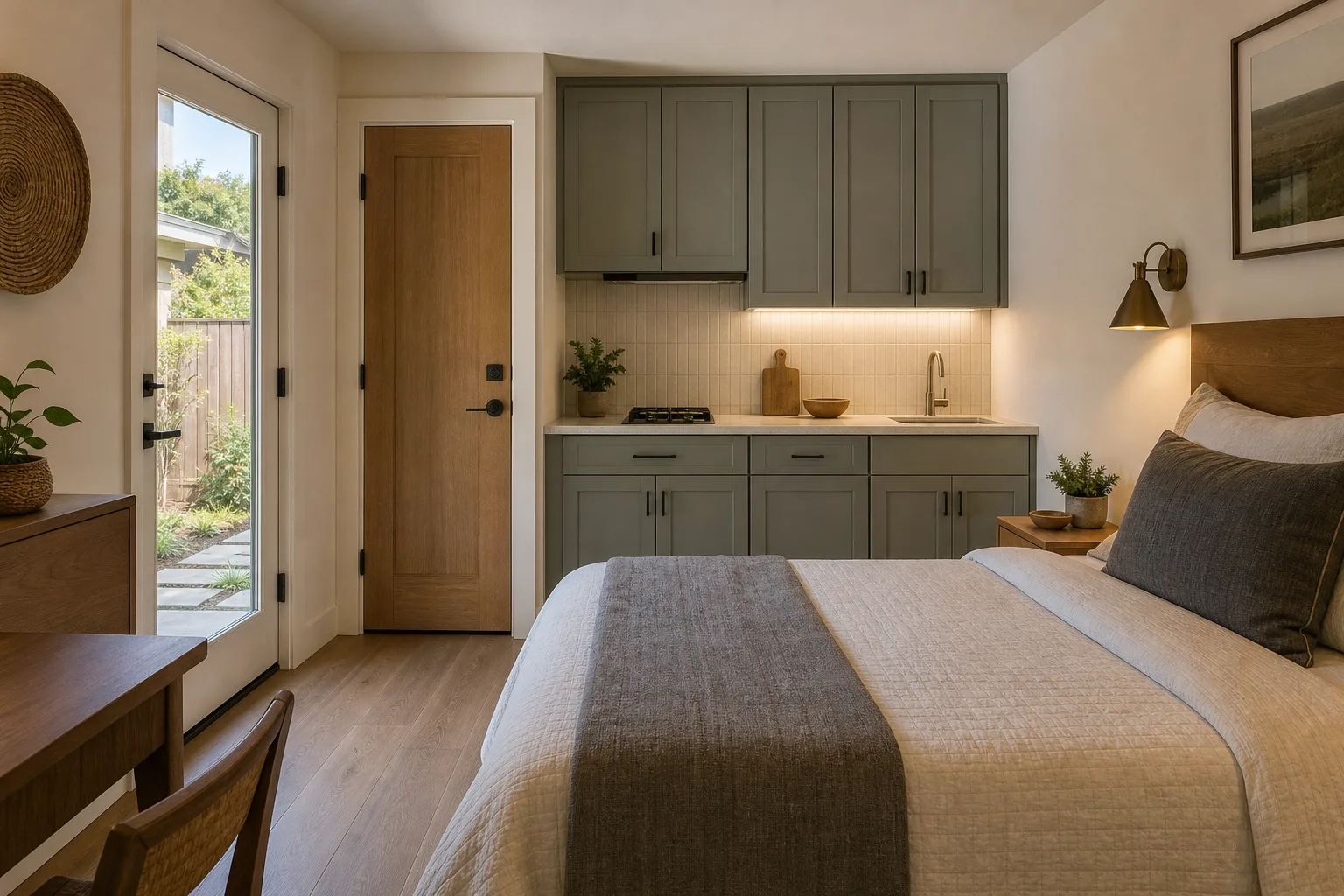
A junior ADU, or JADU, is a separate living unit carved out of a house you already own. It can be a bedroom, a den or an attached garage. It has its own front door, a small kitchen and a place to sleep, and it may share a bathroom with the house. The state sets the outline, and your city fills in the rest.
This guide covers the legal definition, what the state guarantees you, what the conversion involves in the walls and wiring, how a JADU differs from a full ADU, and what each of the seven cities we serve publishes. Where a city said nothing, we say so.
What a JADU is under California law
HCD's ADU Handbook (March 2026) defines it in one line: "A 'junior accessory dwelling unit' or JADU is a unit that is no more than 500 square feet of interior livable space in size and contained entirely within a single-family residence." The statute is Government Code section 66333, and these are the pieces that matter:
- Inside the walls. The unit must be within the walls of the existing or proposed house. Under 66333, an enclosed space such as an attached garage counts as part of the house. A detached garage or backyard building does not. HCD: "JADUs are not allowed in accessory structures."
- Up to 500 square feet, and no more. HCD also says a JADU cannot add the 150 square feet that a converted accessory structure may add for access.
- One per lot. "Only one JADU may be created per lot zoned for single-family residences with an existing or proposed single-family residence."
- Its own entrance. A separate entrance from the house's main entrance. Without a bathroom of its own, the unit also needs an interior entrance to the main living area.
- An efficiency kitchen. HCD: "a cooking facility with appliances, a food preparation counter, and storage cabinets that are of reasonable size in relation to the size of the JADU."
- A bathroom, shared or not. The unit "may include separate sanitation facilities or may share sanitation facilities with the existing structure."
A JADU also has to sit on a lot zoned for single-family homes. HCD says a duplex does not qualify, while each side of a half-plex can have one. (HCD ADU Handbook; Gov. Code 66333, FindLaw text)
What the state guarantees a JADU
State law limits what a city can do to a JADU application. These are the protections we found in the statute and the handbook.
- Staff approval, not a hearing. Section 66335 says a JADU application is considered "ministerially, without discretionary review or a hearing." The city must say within 15 business days whether the application is complete, and must approve or deny within 60 days of a complete one. A delay you ask for pauses the clock.
- No parking. HCD: "Local agencies may not require parking as a condition to permitting a JADU, even when the JADU is converted from an attached garage." (Gov. Code 66334)
- No separate utility connection. HCD: a JADU created from existing space "cannot be required to install a new or separate connection" unless it is built together with a new house. Section 66338 adds that for "water, sewer, or power service," a JADU is not treated as a separate or new dwelling unit.
- No utility capacity charge as a new home. HCD says a JADU "shall not be considered" a new residential use when connection fees or capacity charges are figured. HCD also says a JADU of 500 square feet or less is exempt from impact fees.
- Fire rules. Section 66337 says a JADU "shall not be considered a separate or new dwelling unit" for fire and life protection rules. HCD says sprinklers are not required for a JADU if the main house has none, and adding one cannot trigger sprinklers for the house.
- Old problems cannot sink it. Section 66336 says an agency cannot deny a JADU permit over zoning nonconformities, code violations or unpermitted structures that do "not present a threat to public health and safety."
What the state does not decide is the construction itself. The building code still applies to the work, and the city still inspects it. Section 66334 says a city may require an inspection, with a fee, to confirm the JADU "complies with applicable building standards."
What this means for your project
A junior ADU lives or dies on the kitchenette, the door and the deed restriction. Dallas can look at the bedroom and the panel on one visit.
CSLB #1045801 · 4.6 from 19 Google reviews · Dallas answers the phone
Owner-occupancy, the deed restriction and the rental term
A JADU comes with strings that a full ADU does not. They run with the property, so read them before you plan.
- Owner-occupancy. HCD: "If a JADU has shared sanitation facilities with the primary structure, owner-occupancy will be required." If it has its own bathroom, it is not required. "The owner must reside in either the remaining portion of the primary residence or in the newly created JADU."
- A recorded deed restriction. The ordinance must "require the recordation of a deed restriction" that includes only "a prohibition on the sale of the JADU separate from the sale of the single-family residence" and a restriction on the size and attributes of the JADU. HCD says an ADU cannot get a deed restriction, but a JADU can.
- Rental term. HCD says JADUs "cannot be used as short-term rentals" and, if rented, "must be rented for longer than 30 days."
A JADU is part of your house, not a separate parcel. You cannot sell it alone, and owner-occupancy can shape who lives where if you later move out. We do not give tax, rent or financing advice. Talk to the city and a tax professional about the occupancy and rental pieces.
What the conversion involves
On paper a JADU is a bedroom with a few extra rules. In the walls it touches six things. For each one we say what the law and the cities say, and where we found nothing.
The exterior door
The unit needs an entrance separate from the main one. If the room is on an outside wall, that can mean a new opening or swapping a window for a door, which is framing, a header and weatherproofing. Our windows and doors guide covers permits and what changes in a wall. Azusa's ordinance also says a converted unit must have "exterior access that is independent of that for the single-family dwelling."
The kitchenette
The statute's efficiency kitchen is a cooking facility with appliances, a food preparation counter and storage cabinets of reasonable size. HCD says a city "cannot be more restrictive than this definition," so requirements such as "counter or cabinet sizes, specified electrical or gas connections, or appliance types are not authorized by State JADU Law." HCD adds that "220V circuits are not required for an efficiency kitchen." The definitions we read do not name a sink, and we did not find a source that says whether plan check expects one. Ask. If the kitchenette needs water and a drain, that is plumbing, and it has to reach the existing lines.
The door to the house
HCD says a JADU is "required to be within the walls of the primary dwelling but are not required to have an interior connection to the primary dwelling." The exception is a unit with no bathroom of its own, which must have an interior entrance to the main living area. Whether that interior door locks from one side or both is not something we found in the state rules. Ask your city before you buy hardware.
Sound, light, egress and fire separation
We did not find a state or city source we opened that sets sound insulation, an emergency escape window or a fire-rated wall between a JADU and the house, so we are not stating one. These come from the building code and from plan check. Section 66337 keeps the JADU from being treated as a separate dwelling for fire and life protection rules, but it lets a city apply fire rules that "apply uniformly to all single-family residences" in the zone. Ask plan check for a written list of what they want to see on the plans for each.
Circuits and the panel
A kitchenette, a small heater or cooler and a bed's worth of outlets add load. The load calculation belongs to your electrician and the city. Our ADU utilities guide explains how panel capacity is checked, and our panel upgrade guide covers the main-house side.
An attached garage
A garage is allowed for a JADU, and the state lets a city require no replacement parking. But a garage floor, door and walls were not built to be a room, so the work can run well past a bedroom's. Our garage conversion vs detached ADU guide goes through it.
How a JADU differs from an ADU
Both are legal second units. The difference is size, location and the strings attached. Our ADU rules guide and ADU page cover the full ADU in detail.
- Location. A JADU must be inside the house, attached garage included. An ADU can be a conversion, an addition or a detached building.
- Size. A JADU is capped at 500 square feet. A city's ADU maximum must allow at least 850 square feet, or 1,000 with more than one bedroom.
- Bathroom. A JADU may share the house's. Glendora's handout says an ADU "must include a bathroom containing a bathtub or shower."
- Owner-occupancy. HCD: a city cannot impose it on an ADU, apart from a narrow case. A JADU that shares a bathroom requires it.
- Deed restriction. Allowed for a JADU, not for an ADU.
- Count. One JADU per lot. HCD says cities must allow at least one ADU from existing space, one JADU and one new detached ADU on a single-family lot, so they can combine.
When a JADU is the better choice
A JADU fits when the room already exists and the lot has no backyard for a new building, when you live there and plan to stay, and when the occupant can share a bathroom with the house or a small one is easy to add. It also fits when you want to avoid the utility work of a new building, since state law keeps a JADU from being treated as a new home for service and capacity charges.
- It does not fit if you may move out and want the freedom to rent the whole property without an owner on site, if you want to sell the unit separately, or if you need more than 500 square feet. A full ADU has none of the deed restriction or sale limits of a JADU, and no owner-occupancy rule for most ADUs.
- Think about the house. The unit shares walls with your bedrooms or living areas. Noise, privacy and a shared bathroom's schedule are daily questions that no permit answers.
If you are not sure, we look at the room and the lot together. Your written quote names the work for the option you choose.
What the seven cities publish about JADUs
Each entry is what we read on the city's own site. A city that says nothing about JADUs is still bound by state law. Treat every item as a question to confirm.
- San Dimas. We did not find a JADU rule. The Building and Safety 2025 ADU Requirements handout does not mention junior units, and we did not find a dedicated ADU page on sandimasca.gov. Ask Planning which ordinance covers a JADU.
- Glendora. The most complete. The handout (revised April 2025) calls a JADU "a smaller unit (maximum of 500 square feet) located entirely within a single-family home," lists the recorded deed restriction items, a rental term "of no less than 30 days" and owner-occupancy of either the house or the JADU, and says "Detached JADUs are not permitted." It says a JADU "may share a bathroom," needs a kitchen with "cooking facilities, food prep counter, and storage," and must match the house's style, materials, doors, windows, trim and roof. The city page says a deed restriction requiring owner-occupancy must be recorded if the bathroom is shared, and links a sample covenant agreement.
- La Verne. The Planning application guide is titled for an "Accessory Dwelling Unit (ADU) or Junior ADU." What we read is a checklist and fee form. We found no JADU size or occupancy rule on the pages we opened.
- Claremont. The ADU page lists a JADU maximum of 500 square feet, "within the walls of a proposed or existing single-family residence" with "its own separate entrance" and "a permanent kitchen." It says "Only one JADU is permitted per single-family residential lot" and points to Chapter 16.333. It does not address owner-occupancy or a deed restriction.
- Covina. The planning page mentions JADUs only as part of the title of Chapter 17.69, "Accessory Dwelling Units & Junior Accessory Dwelling Units," on the city code site. It gives no JADU size or requirements. It lists the Planning Division at (626) 384-5400.
- West Covina. The May 2025 one-page guideline sheet lists one ADU and one JADU per lot, a 500-square-foot JADU that "must be attached" and "entirely within a single-family residence," owner-occupancy of the house or the JADU, no parking, and no rental for 30 days or less. It says "No separate utility connection" between the ADU or JADU and the main dwelling, which lines up with the state rule for a JADU.
- Azusa. Ordinance No. 2024-08 defines a JADU as 500 square feet or less, inside the house or an attached garage, with an efficiency kitchen, and ties it to Government Code 66333 through 66339. It says "all JADUs are subject to an owner-occupancy requirement." HCD says that requirement applies when sanitation is shared, so ask Azusa how it treats a JADU with its own bathroom. The ordinance also bars rentals under 30 days and requires a business license and rental registration.
Where a city handout and the state handbook read differently, ask the city in writing which one it applies to your lot. For permits on other work, see remodel permits in the SGV.
Questions to ask the planner before you design
- "Which ordinance covers a JADU on my lot, and what is its date?"
- "Does the unit need its own bathroom here, and how do you treat owner-occupancy if it has one?"
- "What does plan check want shown for the kitchenette, the exterior door, the interior door, the emergency escape window, sound and any fire separation?"
- "What is the deed restriction form, and who records it?"
- "Does the house have sprinklers today?" It decides the sprinkler question.
Dallas walks the room or the garage first, and your written quote names the work and the permit items. To start, ask for a walk-through or call Dallas at (626) 991-8219.
Questions we get
Does a JADU need its own bathroom?
No. HCD says a JADU "may include separate sanitation facilities or may share sanitation facilities with the existing structure." If it has no bathroom of its own, it must have an interior entrance to the main living area as well as its own exterior entrance. Sharing a bathroom is also what triggers the owner-occupancy rule.
Can I sell a JADU separately from my house?
No. The deed restriction the city records must include "a prohibition on the sale of the JADU separate from the sale of the single-family residence," per HCD's handbook. The JADU stays part of the house. Glendora's handout lists the same item.
Does a JADU need parking, or its own meter?
HCD: "Local agencies may not require parking as a condition to permitting a JADU, even when the JADU is converted from an attached garage." A JADU created from existing space also "cannot be required to install a new or separate connection." Whether you choose to add one is a separate question for the city and the utility.
Does a JADU need fire sprinklers?
HCD says sprinklers are not required for a JADU if the main house does not have them, and adding a JADU cannot make the main house need them. If the house already has sprinklers, ask the city how the JADU is covered. Under Government Code 66337, a JADU is not treated as a separate or new dwelling unit for fire and life protection rules.
Can a JADU be a short-term rental?
No. HCD says JADUs "cannot be used as short-term rentals" and, if rented, "must be rented for longer than 30 days." Glendora, Azusa and West Covina each repeat a 30-day minimum in their own documents.
Note: general background, not legal advice. JADU rules differ by city and change often; confirm with your city's planning staff before you design, record a deed restriction or spend anything.
Sources
All pages opened and read November 13, 2026. Rules change. Confirm with your city before you rely on any of this.
Every source, with the date we read it
State law and HCD
- HCD, Accessory Dwelling Unit Handbook, March 2026 (PDF; text extracted locally; JADU section and the deed restriction, fee, utility, fire and owner-occupancy questions): https://www.hcd.ca.gov/sites/default/files/docs/policy-and-research/ADU-Handbook-Update.pdf (read November 13, 2026)
- California Government Code section 66333 (JADU ordinance; text as published by FindLaw, since the official leginfo page blocks automated reads): https://codes.findlaw.com/ca/government-code/gov-sect-66333/ (read November 13, 2026)
- Government Code section 66334 (no added parking; inspection): https://codes.findlaw.com/ca/government-code/gov-sect-66334/ (read November 13, 2026)
- Government Code section 66335 (ministerial approval, 15-business-day completeness check, 60-day decision): https://codes.findlaw.com/ca/government-code/gov-sect-66335/ (read November 13, 2026)
- Government Code section 66336 (no denial over nonconforming conditions): https://codes.findlaw.com/ca/government-code/gov-sect-66336/ (read November 13, 2026)
- Government Code section 66337 (fire and life protection): https://codes.findlaw.com/ca/government-code/gov-sect-66337/ (read November 13, 2026)
- Government Code section 66338 (water, sewer and power service): https://codes.findlaw.com/ca/government-code/gov-sect-66338/ (read November 13, 2026)
- Government Code section 66339 (when a city has no JADU ordinance): https://codes.findlaw.com/ca/government-code/gov-sect-66339/ (read November 13, 2026)
City pages
- City of San Dimas, ADU Requirements (2025) (PDF): https://files.sandimasca.gov/Documents/Departments/Community%20Development/Building%20and%20Safety/Forms%20and%20Handouts/2025/ADU%20Requirements%2025%20FINAL.pdf (read November 13, 2026)
- City of Glendora, Accessory Dwelling Units and SB 9 (page): https://www.cityofglendora.gov/Services/Development-Services/Planning/Accessory-Dwelling-Units-SB-9 (read November 13, 2026)
- City of Glendora, ADU, JADU, and Guest House Standards (handout revised April 2025, PDF): https://www.cityofglendora.gov/files/assets/city/v/1/community-development/planning-division/documents/handouts/adu-handout-oct-2024.pdf (read November 13, 2026)
- City of La Verne, Planning Development Application for an ADU or Junior ADU (guide, PDF): https://www.laverneca.gov/DocumentCenter/View/4157/Accessory-Dwelling-Unit-ADU-Application-Guide-PDF (read November 13, 2026)
- City of La Verne, Planning Applications (page): https://www.laverneca.gov/662/Planning-Applications (read November 13, 2026)
- City of Claremont, Accessory Dwelling Units (page): https://www.claremontca.gov/Business-Development/Planning-and-Land-Use/Accessory-Dwelling-Units (read November 13, 2026)
- City of Covina, Accessory Dwelling Unit (ADU) (page): https://covinaca.gov/city-departments/community-development/planning/adu/ (read November 13, 2026)
- City of West Covina, ADU and JADU Guidelines, updated 05/2025 (PDF): https://www.westcovina.gov/DocumentCenter/View/434 (read November 13, 2026)
- City of Azusa, Ordinance No. 2024-08 (PDF): https://www.azusaca.gov/DocumentCenter/View/48647/Ordinance-No-2024-08---ADU-Ordinance (read November 13, 2026)