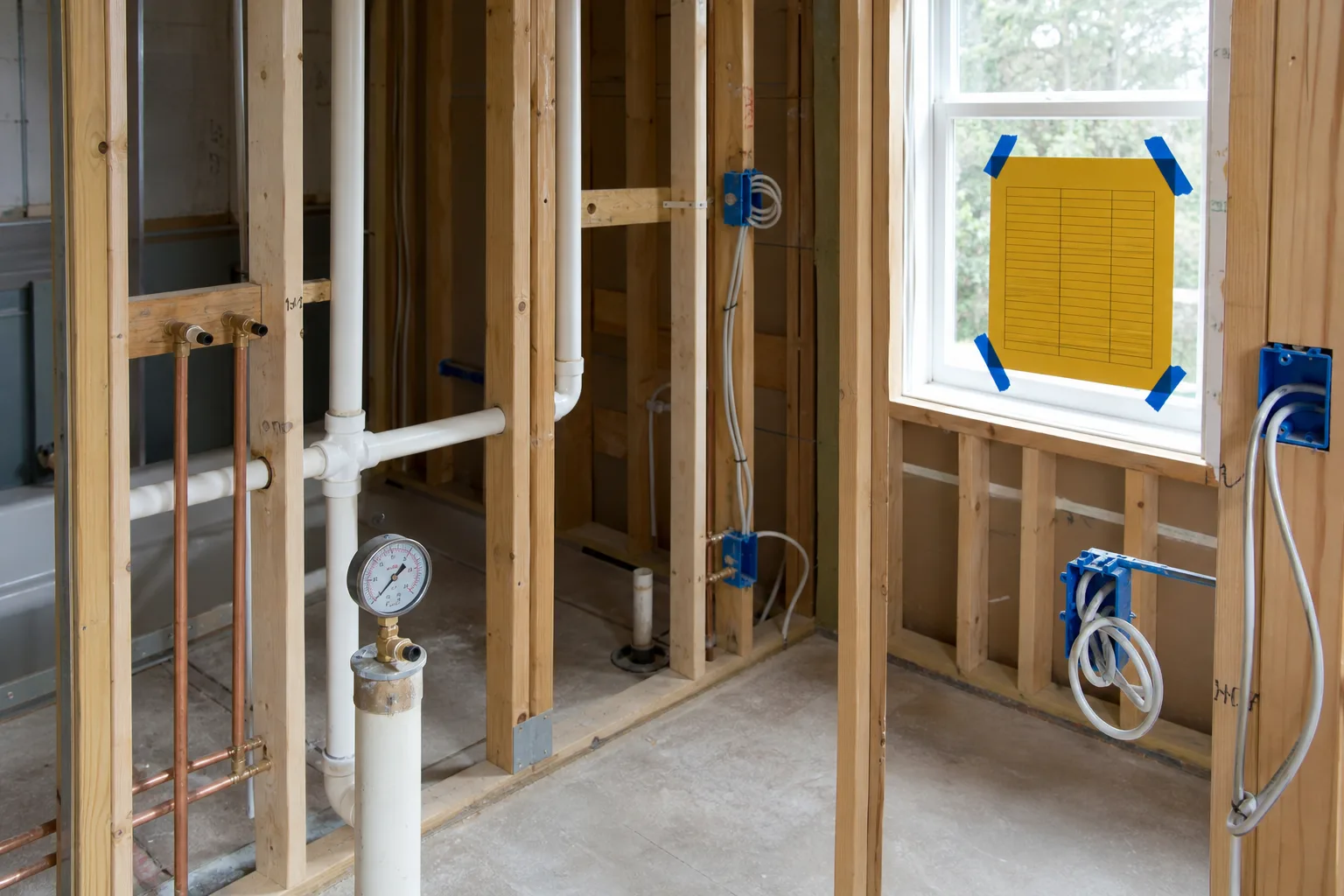
An inspection is a city inspector looking at work before it disappears behind a wall, under a floor or inside a shower. That is the whole idea. Our how long a remodel takes guide shows where inspections sit in the schedule. This guide goes the other way: what each inspection is, what has to be ready, and what the inspector is there to see.
We read seven city pages and the state code to write it. Where a city did not publish something, we say so rather than guess.
The one rule behind every inspection
The California Residential Code (CRC) is the state's rulebook for homes. Its inspection section says rough inspection of "plumbing, mechanical, gas and electrical systems shall be made prior to covering or concealment." It also says: "Work shall not be done beyond the point indicated in each successive inspection without first obtaining the approval." (CRC R109.1.2 and R109.4, 2022 edition, UpCodes)
That is what "do not cover" means. The pipe stays visible, the wire stays visible, and drywall stays in the garage until the inspector has said yes. Covina writes it for homeowners: "All construction that requires a permit shall be inspected before it is covered or concealed." (Covina IB-15)
It is also why the inspector is on the schedule at all. Not every cabinet-and-counter job needs a permit, and so not every job gets inspections. See do you need a permit to remodel in the SGV? When a permit is needed, our how we work page lists inspections where the city requires them as part of the build.
Rough plumbing, electrical, mechanical and gas
"Rough" means the system is installed but not finished: pipes in the walls, wires pulled, ducts run, and no drywall yet. Azusa's required-inspections list names "Rough Plumbing," "Rough Electric," "Mechanical Ducts" and "Gas Test" as separate stops. (Azusa Required Inspections)
- Plumbing. The inspector looks at the supply and drain lines while they are open. We tried to open the plumbing code's testing section (CPC 712) and the pages we reached would not load, so we are not quoting the test method here. Ask your contractor which test your city's inspector will want.
- Electrical. Wiring, boxes and the panel are inspected open. Covina adds a practical rule: "All electrical panels and junction boxes to be inspected shall be open and accessible for inspection. Inspectors will not open boxes or take apart electrical equipment." Details such as box fill, nail plates and arc-fault protection come from the electrical code, which we did not open for this guide, so we are not listing them as the city's rules.
- Mechanical. Ducts and bath fans are checked before they are covered. Covina's bath remodel handout asks for a fan of "50 CFM for intermittent operation and 25 CFM for continuous operation." (Covina Handout #09)
- Gas. Azusa lists a "Gas Test" on its own. The CRC groups gas with the other rough inspections.
Handout #09 also tells you what the finished bath electrical will be held to, so the rough wiring has to plan for it: "a 20 AMP GFCI protected electrical outlet within 36" of the outside edge of each bathroom sink basin," tamper-resistant receptacles, and fixtures over the tub or shower "marked as suitable for damp locations." (Covina Handout #09)
What this means for your project
We schedule the inspections and we are there for them. Your written quote lists which ones your job will have.
CSLB #1045801 · 4.6 from 19 Google reviews · Dallas answers the phone
Framing, shear, insulation, drywall nailing and lath
These inspections are about what holds the house up and what closes it in. They apply when walls move, a window opens up, or an ADU goes in.
- Framing and shear wall nailing. Azusa lists "Framing" and "Shear Wall Nailing." The CRC says inspection of framing "shall be made after the roof, masonry, framing" and related items are in place. The inspector sees the structure before insulation hides it. (Azusa Required Inspections; CRC R109.1.4)
- Insulation. Azusa and San Dimas both list it. It is checked in the open wall, before drywall.
- Drywall nailing. Azusa lists "Drywall Nailing" and San Dimas lists "Drywall." This is the last look before taping. Where a wall or ceiling has a fire rating, the CRC wants an inspection "after lathing or gypsum board or gypsum panel products are in place." (CRC R109.1.5.1)
- Lath and stucco. For an exterior change, Azusa lists "Interior/Exterior Lath" and San Dimas lists "Exterior Lath." The lath goes on, the inspector looks, and then the stucco goes over it.
San Dimas calls these "the minimum inspections" and lists "Foundation, Framing, Rough Electrical, Plumbing, HVAC, Insulation, Drywall," then "Exterior Lath, Roof Sheathing and Final." Your job gets the ones that match the work. That decision belongs to the city. (San Dimas Inspections)
Showers and the flood test
A shower is where hidden mistakes cost the most, so the pan and waterproofing get their own care. We found two sources worth quoting, and one gap.
- Covina's bath handout says "Site built shower receptors shall comply with CPC 408.8." (Covina Handout #09)
- One waterproofing manufacturer says that "in the absence of, or in addition to, specific building code requirements," it "recommends a 24-hour flood test for the waterproofing system." That is one product's data sheet, not a city rule. (Schluter-KERDI-DS data sheet)
- Not found in our research: any of the seven cities saying a flood test is required, or how it is witnessed. Ask the city before the pan is built.
For the full picture of converting a tub to a shower, see tub-to-shower conversion.
Title 24 energy checks and the rater
Some energy-code items are not checked by the city inspector at all. They are checked by a certified rater, who tests the installed equipment. The California Energy Commission says the rater "will inspect and interact with the home's various features (HVAC equipment, air ducts and vents, and thermostat)." It tells homeowners to confirm their rater is a "HERS provider certified Field Verification and Diagnostic Testing rater." (California Energy Commission)
The same page says that effective January 1, 2026, this testing moved to the Energy Code Compliance (ECC) Program: "the HERS Program no longer supports an Energy Code compliance demonstration program." The names are changing. The idea is the same: a third party tests the work.
When does your job need one? Mostly when heating and cooling equipment or ducts are involved. We did not find a published list for the kitchen and bath work itself, so ask us and your city. For the broader energy-code picture, see Title 24 energy rules in a remodel.
The final inspection and the ADU certificate of occupancy
The CRC says: "Final inspection shall be made after the permitted work is complete and prior to occupancy." San Dimas lists "Plumbing, HVAC, and electrical finals" and a "Building Final." (CRC R109.1.6; San Dimas Inspections)
What the city checks at final is in the code and the city's handouts. We found these written down:
- Alarms. Covina's handout says "Bathroom renovations (projects over $1,000) will require that smoke and carbon monoxide alarms for the dwelling are installed to meet the current code." That is the city's threshold, not our price. Alarms must be interconnected if more than one is required, and "in existing conditions, alarms may be battery operated" only when the work does not open walls and ceilings or the attic, basement or crawlspace is not accessible. (Covina Handout #09)
- Fixtures and outlets. The items in the handout above, from the GFCI outlet to the damp-rated lights and the fan, are the standards the finished work is held to.
Not found in our research: a city page listing address numbers or a GFCI test button as a final item. Do not take our silence as a rule either way.
ADUs. A new unit adds one more document. HCD's ADU handbook says: "property owners must obtain a Certificate of Occupancy from the local agency prior to any residential occupancy of an ADU or JADU" (Gov. Code section 66328; 2022 CBC section 111). The CRC's own wording is that "A building or structure shall not be used or occupied" until the building official issues one. Covina's inspection sheet says its certificate "is issued for commercial structures after the inspections are completed," so ask Covina what it issues for an ADU. See our ADU construction page and ADU rules in the San Gabriel Valley. (HCD ADU Handbook; CRC R110.1; Covina IB-15)
Corrections, and who has to be there
If something fails. We did not find a correction notice described on any of the seven city pages. What the pages do say: Claremont says "Re-inspections will be made as requested." San Dimas says "All changes to the scope of work require City approval," and that a passed inspection is needed at least every six months or the permit can expire. A failed inspection means the fix gets made and a new request goes in. Any change to the contract goes through a written change order first. See how change orders work.
Who attends.
- Covina. "An adult 18 years of age or older must be present to allow access to the inspection site." Have the "approved plans and documents" and the "inspection record card" ready, secure pets, and keep a "safe path of travel." Crawl spaces "must be dry, free of obstruction." (Covina IB-15)
- San Dimas. The general contractor, the homeowner or their duly authorized representative must be present, and must be 18 or older. For roof or attic work, a ladder has to be provided for the inspector. (San Dimas Inspections)
- Claremont. Before you ask: "it is the general contractor/owner-builder's or their duly authorized representative's responsibility to verify that all work to be inspected is complete." (Claremont Inspections)
Glendora, West Covina, Azusa and La Verne did not say on the pages we read. Ask your contractor who will be on site, and put it in your quote.
How each of our seven cities takes the request
Processes are different and they change. This is what each city's page said when we read it on November 13, 2026. Each city's permit rules are on its own page: San Dimas · Glendora · La Verne · Claremont · Covina · West Covina · Azusa.
- San Dimas. "To schedule an inspection, please click the icon above to be redirected to the online portal." The page lists hours as Monday through Thursday, 7:30 am to 5:30 pm and Friday, 7:30 am to 4:30 pm, main line 909.394.6200. To cancel or reschedule, call 909.394.6260. You cannot pick a time. (San Dimas Inspections)
- Glendora. Online through the Civic Access portal: "Inspection requests must be submitted by 4:00 p.m. on the business day prior to the requested inspection." Inspection hours are Monday through Friday, 9:00 a.m. to 3:30 p.m. The time posts "after 8:00 a.m." on the day. Older permits (before July 2025) use a phone system, (626) 657-7273. Questions go to the Building Division at (626) 914-8222. (Glendora Inspections)
- La Verne. We did not find an inspection-request process on the city pages we could read. The Building Department phone is 909-596-8706, and City Hall hours are Monday through Thursday, 7:30 a.m. to 5:30 p.m. Call before you plan around a date. (La Verne Permits)
- Claremont. Use the online Inspection Request form with your address, type of inspection, permit number and a phone number. "Inspection Hours: M-Th, 8:00 a.m. to 5:00 p.m." Building Division phone (909) 399-5471. The page also posts the next available inspection date, and when we read it, it noted staff could not send or receive emails temporarily. (Claremont Inspections)
- Covina. Email bldinspections@covinaca.gov or phone the request line at (626) 384-5461 with address, permit number, inspection number, type and your contact details. "Inspections requested received before 3:00 pm will be scheduled for the next business day." Hours are Monday through Thursday, 7:00 am to 6:00 pm, and "The City of Covina is CLOSED on Friday." The IB-15 sheet is dated 2020, so check it is current. (Covina IB-15)
- West Covina. The Building Division page lists "Inspection Request: 626-939-8425." It gives no inspection hours or cutoff time. Its counter hours, Monday through Thursday, 7:30 am to 5:30 pm, are for applications. (West Covina Building Division)
- Azusa. Call "Building Inspection Requests" at (626) 812-5234. The page does not list hours or a cutoff. Its required-inspections list for a single-family dwelling runs from "Footings/Setbacks" to "Final Inspection." (Azusa Building Permit Process; Required Inspections)
Covina closes on Fridays and Claremont inspects Monday through Thursday, so a request made late in the week may not become an inspection until the next one. That is a city calendar, not a contractor delay.
Getting ready, as a homeowner
- Keep the permit card and plans on site. Covina asks for both at the inspection. Ask your contractor where they will be kept.
- Do not cover anything early. Do not ask for drywall or a closed-in wall before the inspection has passed, even if the room looks done.
- Clear the path. Panels open, a safe route in, light in the work area, pets away.
- Ask about the schedule in writing. Your written quote has the schedule. Dallas walks you through the order of work before you sign.
Get a written, fixed-price quote or call Dallas at (626) 991-8219.
Questions we get
What does "do not cover" mean?
It means the work has to stay open, with the pipe, wire or framing in plain sight, until the inspector has seen it. The California Residential Code says: "Work shall not be done beyond the point indicated in each successive inspection without first obtaining the approval." Covina puts it as: "All construction that requires a permit shall be inspected before it is covered or concealed."
Do I have to be home for an inspection?
Usually someone does. Covina says "An adult 18 years of age or older must be present to allow access to the inspection site." San Dimas says the general contractor, the homeowner or their duly authorized representative must be present, and that person must be 18 or older. Check your own city before the day.
What if the work fails?
None of the city pages we read describes a correction notice, so we will not invent one. Claremont says "Re-inspections will be made as requested," which tells you the next step is a new request. Ask your inspector what exactly has to be fixed, and get it in writing from your contractor.
Does an ADU get a certificate of occupancy?
Yes. HCD says "property owners must obtain a Certificate of Occupancy from the local agency prior to any residential occupancy of an ADU or JADU." A kitchen or bath remodel is different: the code asks for a final inspection after the work is complete and before occupancy.
Can I book an inspection for a specific time?
Not in the cities that say. San Dimas answers "No, but you can request a preference for a morning or afternoon inspection." Glendora posts the time online after 8:00 a.m. on the day. Covina lists inspection times as roughly 9:00 am to 4:00 pm.
Note: general background, not legal advice or an inspection plan for your job. Each city sets its own process and the inspector on your job decides what applies. Confirm with your city and your contract.
Sources
All pages opened and read November 13, 2026. Rules and times change. Confirm with your city and your contract.
Every source, with the date we read it
City building pages
- City of Azusa, Required Inspections (single-family dwelling list): https://azusaca.gov/119/Required-Inspections (read November 13, 2026)
- City of Azusa, Building Permit Process (inspection request line): https://azusaca.gov/118/Building-Permit-Process (read November 13, 2026)
- City of Claremont, Inspections: https://www.claremontca.gov/Business-Development/Building-and-Construction/Inspections (read November 13, 2026)
- City of Covina, IB-15 Inspection Process (PDF, effective 01/01/2020): https://covinaca.gov/wp-content/uploads/2024/01/IB-15-INSPECTION-PROCESSopt.pdf (read November 13, 2026)
- City of Covina, Handout #09 Residential Bath Remodel (PDF, effective 01/01/2026): https://covinaca.gov/wp-content/uploads/2026/02/09-Handout-Bathroom-Remodel.pdf (read November 13, 2026)
- City of West Covina, Building Division: https://www.westcovina.gov/228/Building-Division (read November 13, 2026)
- City of Glendora, Building and Safety: https://www.cityofglendora.gov/Services/Development-Services/Building-And-Safety (read November 13, 2026)
- City of Glendora, Inspections: https://www.cityofglendora.gov/Services/Development-Services/Building-And-Safety/Inspections (read November 13, 2026)
- City of San Dimas, Inspections: https://www.sandimasca.gov/departments/community_development/building_and_safety/inspections.php (read November 13, 2026)
- City of La Verne, Permits: https://www.laverneca.gov/366/Regulatory-Permits (read November 13, 2026)
California codes and state agencies
- UpCodes, 2022 California Residential Code, Chapter 1 (R109 Inspections, R110 Certificate of Occupancy): up.codes, 2022 California Residential Code, Chapter 1 (read November 13, 2026)
- California Energy Commission, Home Energy Rating System (HERS) Program: https://www.energy.ca.gov/programs-and-topics/programs/home-energy-rating-system-hers-program (read November 13, 2026)
- California HCD, Accessory Dwelling Unit Handbook (PDF): https://www.hcd.ca.gov/sites/default/files/docs/policy-and-research/adu-handbook-update.pdf (read November 13, 2026)
Manufacturer data sheet
- Schluter Systems, Schluter-KERDI-DS technical data sheet (PDF, labeled 04-2026): assets.schluter.com, technical-data-sheet-schluter-kerdi-ds-04-2026.pdf (read November 13, 2026)