
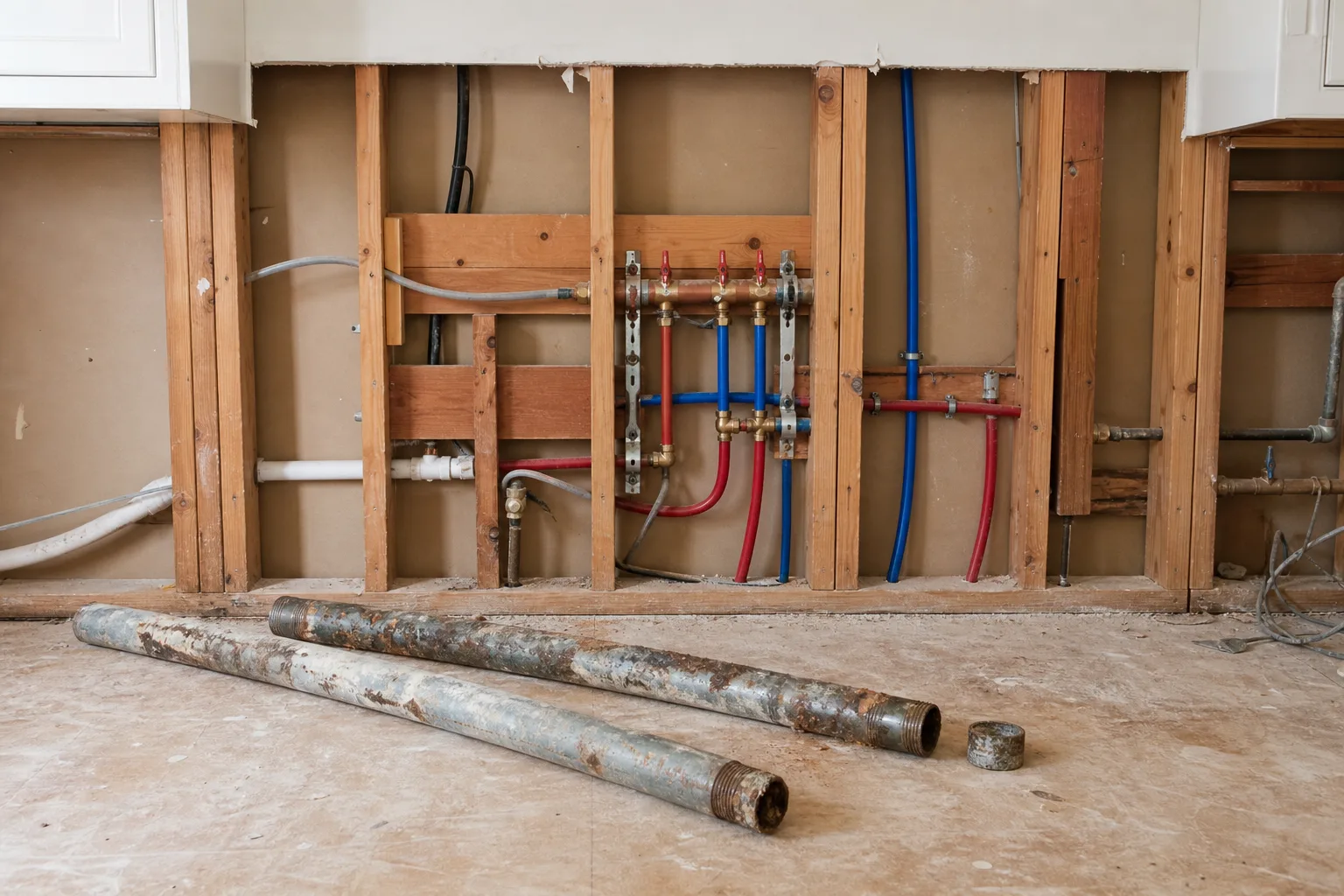
Many houses built in the 1950s through the 70s in the San Gabriel Valley were plumbed with galvanized steel pipe. It lasted for decades. In a lot of those houses, it is now the oldest thing behind the wall you are about to open.
This post covers how to tell what you have, what the options are, what the code and your city care about, and how to decide whether the remodel is the time. For the wider older-house picture, read remodeling a 1960s or 1970s home. We do not price plumbing here; the cost guide explains how our quotes work.
Why do older houses have galvanized supply pipe?
Galvanized pipe is steel pipe with a zinc coating. It was a common choice for water supply in houses built before copper took over, and plenty of homes in our seven cities still have it somewhere. We did not find a government source giving the years it was used in California, so we will not give you a date range. The house's age is a clue, not proof.
It often hides. The runs are inside walls, under the floor and in the attic. The places you can see it are listed in the "what you have" section below.
How does it fail?
Our 1960s and 70s guide already covers a utility's explanation of galvanized pipe corroding from the inside. In a house, it usually shows up as one or more of these:
- Weak pressure at one fixture, or at the far end of the house, while others are fine. Rust builds up inside and the opening gets smaller.
- Brown or rusty water when a tap has not run for a while.
- Leaks at threaded joints. Galvanized pipe is joined with threads, and the joints are where it tends to weep.
- Pipe that is crusty or flaking where you can see it, such as at the water heater or under a sink.
This is our plain description of what plumbers and homeowners report, not a quote from a source. None of these proves the pipe is bad, and a house with none of them can still have pipe near the end of its life. A plumber's look, and a pressure and flow check, tell you more.
What this means for your project
If the walls are open for a kitchen or bath, the repipe question comes up on the first visit. Dallas looks at the pipe at the water heater and under the sink before the quote is written.
CSLB #1045801 · 4.6 from 19 Google reviews · Dallas answers the phone
How can you tell what pipe you have?
Riverside Public Utilities, a California utility, publishes a simple scratch-and-magnet check for service-line pipe. The same idea works on exposed pipe inside a house:
- Copper. Scratch the pipe with a penny. "The material is copper in color, similar to a penny."
- Galvanized steel. The pipe is "not easily scratchable and the color is dull gray." Then try a magnet: "If the magnet sticks, it is galvanized steel."
- Lead. The scratched surface is "shiny and silver," and "A magnet will not stick to a lead pipe." If you think you have lead, stop and call your water utility.
Places to look: the pipes coming off the water heater, under the kitchen and bathroom sinks, at the shutoff where the main enters the house, and in a crawl space or garage if you have access. Pipe can differ behind the wall from what shows at a sink, so this is a clue, not a diagnosis. (Riverside Public Utilities, read November 13, 2026.)
What can replace it?
The usual replacements are copper, PEX and CPVC. We could not open the California Plumbing Code text for free. A City of Beverly Hills plan-check guide for the 2025 code, citing CPC Table 604.1, says: "Approved materials include Copper (Types K, L, M), CPVC, and PEX. PEX tubing must not be exposed to direct or indirect sunlight." It adds that CPVC for interior distribution "requires specific permit conditions, including a mandatory flush procedure." Beverly Hills is not one of our cities, so ask your city's inspector what it accepts.
- Copper (Type L is the common choice). Rigid tube. We could not open a copper trade page, so we say nothing here about wall thickness or where Type M is allowed. Ask your plumber and your inspector.
- PEX. Flexible plastic tubing, sold with different fitting systems, such as expansion fittings. Uponor says its system uses "innovative ProPEX expansion fittings," available in lead-free brass or engineered polymer. This is manufacturer wording, not code.
- CPVC. Rigid plastic. Per the Beverly Hills guide, interior use carries extra permit conditions.
Install details to ask about. Uponor's FAQ gives horizontal support spacing for bare PEX of 32 inches for 1-inch and smaller pipe and 48 inches for larger. On sunlight it says "Uponor AquaPEX white pipe has a one-month UV resistance" and red and blue pipe "have a six-month UV resistance." Those are one maker's numbers. Follow the product's own instructions and your inspector.
Manifold or trunk-and-branch. These are two layouts. A manifold runs a line from one central point to each fixture. Trunk-and-branch runs a larger line through the house with smaller lines off it, much like the old layout. Which fits depends on the house, and we did not find a government source ranking them. Ask your plumber why they picked one.
Water heater and pressure. The Beverly Hills guide says a thermal expansion tank is required at a water heater when the system is "closed" by a check valve, backflow preventer or pressure regulator, and that a pressure regulator is required if service pressure exceeds 80 psi. Covina's water heater handout asks for bonding of metallic piping at the heater. These come up when a repipe touches the heater. Confirm them with your city.
Why is a remodel the easy moment?
Supply pipe in a wall is easy to reach when the wall is already open for the new kitchen or bath, and hard to reach when it is finished. Doing it now can mean one round of demolition and drywall instead of two. The plumber also gets a clean look at what is in the wall.
Whether to do the whole house is a separate decision. Three plain options:
- Only the pipe you are working on. The kitchen or bath walls get new supply. The rest of the house keeps its pipe, and you accept that it may need work later.
- The runs off the remodel, back to a point you choose. A middle path that goes as far as the open walls and the access allow.
- The whole house. More wall and ceiling openings and more patching, and one finished plumbing system. A whole-home remodel makes this easier to plan around.
The tie-in matters even with the first option. New PEX or copper joined to worn galvanized pipe is only as good as the old pipe feeding it. Dallas looks at the supply pipe before the quote is written, and the quote that follows is written, itemized and fixed. Changes go on a written change order. Your written quote has the schedule.
What about the drain lines?
Drains are a separate system and a separate question. Supply pipe brings water in under pressure. Drains carry it out by gravity, and the materials differ. We did not find a government source on how long older drain materials last, so we keep this practical:
- Ask what the drains are made of. A plumber can tell you from the open wall, the crawl space or the garage.
- Ask about a camera look at the sewer line. A plumber runs a camera through the line from the house toward the street. If the remodel is moving a toilet or adding a bath, it is a good time to learn the condition before work starts.
- Ask where steel pipe meets the ground. The Beverly Hills guide says "Galvanized steel and stainless steel 304 pipe and fittings shall not be installed underground and must be kept at least 6 inches aboveground." That is a rule for new work.
Moving a fixture means new drain and vent work as well as new supply. See kitchen island rules and small bathroom layout clearances for how layout decisions drive the plumbing.
What permit and inspection does a repipe need?
Cities treat plumbing as permit work.
- Claremont. Its permit page lists "Plumbing work" and "Water heater replacement, relocation or installation" as work requiring a building permit. Claremont details.
- Covina. Handout #14 says "A Plumbing permit is required for the installation, alteration, repair, replacement, and/or remodeling of plumbing systems." Handout #12 says a plumbing permit is required for all water heater replacements. Covina details.
- San Dimas. Moved plumbing needs a permit. San Dimas details.
- Other cities. West Covina says most any work needs a permit. We did not find a published plumbing-specific rule for Glendora, La Verne or Azusa. Glendora, La Verne, Azusa, West Covina.
Inspection. Covina's IB-15 says "All construction that requires a permit shall be inspected before it is covered or concealed," and that crawl spaces must be dry and safe, with an adult present. For plumbing, that means the new pipe is inspected before the wall closes. We could not open the code text on pressure testing, so we do not state a test rule. Ask your inspector what test your city requires and when. See remodel inspections explained.
Water heater. Covina's handout asks for seismic straps at the upper and lower thirds of the heater, temperature and pressure relief installed "in accordance with their listing," and bonding of metallic piping at the heater. If a repipe touches the heater, expect it to be looked at. We pull the permits on the jobs we build.
Is there a lead question?
There can be, and it helps to know what the sources do and do not say. EPA says "The most common sources of lead in drinking water are lead pipes, faucets, and fixtures," and that in homes without lead service lines "the most common problem is with brass or chrome-plated brass faucets and plumbing with lead solder." Galvanized pipe itself is not on that EPA page.
The California State Water Resources Control Board does mention it. Its service-line inventory page defines "Galvanized Requiring Replacement" as a service line "where a downstream portion is galvanized and the upstream portion is" lead, of unknown material, or not shown to have never been lead. It says "the downstream galvanized pipe can (or potentially) adsorb lead and contribute to lead in drinking water." That page is about water systems' service lines, so it does not say your house pipe has lead.
EPA's tips for reducing exposure include: "Use only cold water for drinking, cooking and making baby formula," "Before drinking, flush your home's pipes by running the tap," and "If you use a filter, make sure you use a filter certified to remove lead." To learn what your utility knows about the line to your house, call the utility. If testing matters to you, ask a certified lab. See lead and asbestos testing before demo for the paint side.
Questions we get
Can I just leave the galvanized pipe and remodel around it?
Sometimes, if a plumber finds it in good shape. The scratch-and-magnet check only tells you the material, not the condition. Ask for pressure and flow to be checked, and for a look at the pipe that will feed your new fixtures.
Is PEX allowed in California?
Yes. A City of Beverly Hills plan-check guide for the 2025 California Plumbing Code says "Approved materials include Copper (Types K, L, M), CPVC, and PEX." It also says PEX must not be exposed to direct or indirect sunlight. Your city's inspector applies the code, so confirm the product and fittings with them.
Does galvanized pipe mean there is lead in my water?
Not necessarily. The State Water Board says galvanized pipe downstream of a lead service line "can (or potentially) adsorb lead and contribute to lead in drinking water." That is about a utility's service lines, not proof about your house. If you are worried, ask your water utility and use a filter certified to remove lead.
Does repiping mean opening every wall?
It can mean opening a lot of them, which is why the timing matters. Where the walls are already open for a kitchen or bath, the supply work there is easier to reach. The rest of the house depends on the layout, and a plumber has to walk it before anyone can say.
Do I need a permit to repipe?
Claremont lists "Plumbing work" as work requiring a building permit, and Covina's handout says a plumbing permit is required for "alteration, repair, replacement, and/or remodeling of plumbing systems." We pull the permits on the jobs we build. Check your own city.
Note: general background, not legal or plumbing engineering advice. Codes and city rules change, and every house is different. Only a licensed plumber's look at your pipes and your city's building department can tell you what your house needs.
Sources
All pages opened and read November 13, 2026. Codes and city rules change. Confirm with your city before you plan work.
Every source, with the date we read it
Lead and galvanized pipe
- California State Water Resources Control Board, Statewide Service Line Inventory Data (Galvanized Requiring Replacement): https://www.waterboards.ca.gov/drinking_water/certlic/drinkingwater/lead-copper-rule/service-line-data.html (read November 13, 2026)
- U.S. EPA, Basic Information about Lead in Drinking Water: https://www.epa.gov/ground-water-and-drinking-water/basic-information-about-lead-drinking-water (read November 13, 2026)
- Riverside Public Utilities, Lead Awareness (how to identify pipe material): https://riversideca.gov/utilities/residents/our-water/lead-awareness (read November 13, 2026)
Plumbing code (secondary summary; the code text itself would not load)
- City of Beverly Hills, Residential MEP Plan Check Reference Guide, 2025 CPC (PDF; a plan-check summary citing CPC sections): https://www.beverlyhills.org/DocumentCenter/View/15062/Residential-MEP-Plan-Check-Reference-Guide (read November 13, 2026)
Manufacturer wording
- Uponor, FAQs (PEX support spacing, UV resistance, ProPEX fittings). Manufacturer wording, not code.: https://www.uponor.com/en-us/customer-support/faq (read November 13, 2026)
City permits and inspections
- City of Claremont, When do I need a permit: https://www.claremontca.gov/Business-Development/Building-and-Construction/Building-Permits-and-Plan-Checks/When-do-I-need-a-permit (read November 13, 2026)
- City of Covina, Handout #14, Citizen's Guide to Residential Mechanical, Electrical, Plumbing Permits (PDF): https://covinaca.gov/wp-content/uploads/2026/02/14-Handout-Guide-for-Mech-Elec-Plumbing-Permit.pdf (read November 13, 2026)
- City of Covina, Handout #12, Residential Water Heater (PDF): https://covinaca.gov/wp-content/uploads/2026/02/12-Handout-Water-Heaters.pdf (read November 13, 2026)
- City of Covina, IB-15 Inspection Process (PDF): https://covinaca.gov/wp-content/uploads/2024/01/IB-15-INSPECTION-PROCESSopt.pdf (read November 13, 2026)